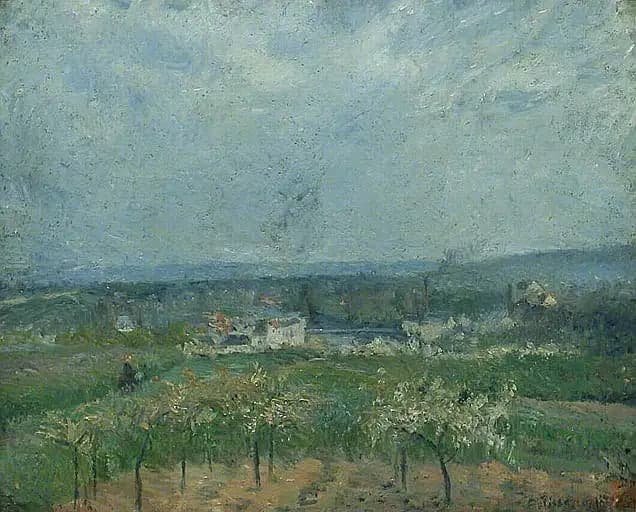
Landscape at Pontoise
- Original dimensions
- 55 x 46 cm
- Museum
- Ashmolean Museum
- Year
- 1872
Scene depicted
This painting evokes a precious moment of nature, delicately blending light and shadow. The scene depicts a rural landscape bathed in soft sunlight, where lush vegetation and the azure sky create a visual harmony. Each stitch of color on the canvas reveals the magic of everyday life, celebrating the simplicity of a world where nature and man intertwine.
Historical context
Created in 1872, this iconic painting has its roots in Pontoise, a picturesque town located in the Île-de-France region. Landscape at Pontoise , created by Camille Pissarro , is part of the Impressionist movement. At that time, France was experiencing an unprecedented artistic effervescence, highlighting the beauty of rural scenes and natural light. Currently, this painting is housed in the prestigious Ashmolean Museum , where it continues to inspire visitors with its delicate dimensions of 55 x 46 cm.
Place in the artist's career
Landscape at Pontoise marks a significant milestone in Pissarro's career. This painting represents the blossoming of his Impressionist style. In parallel, his other works, such as Rue de l'Église, Pontoise or Les Jarres , also illustrate his evolution, demonstrating an increased mastery of light and color. With Landscape at Pontoise , he approaches the maturity of his art, consolidating his reputation as the father of Impressionism .
Anecdote
Camille Pissarro once stated: "Beauty lies in the identification with the landscape." This masterpiece was born from a spring morning when Pissarro, drawn by the vibrant splendor of nature, captured the moment of perfect serenity, allowing him to transcribe the intangible emotion of the moment onto his canvas .