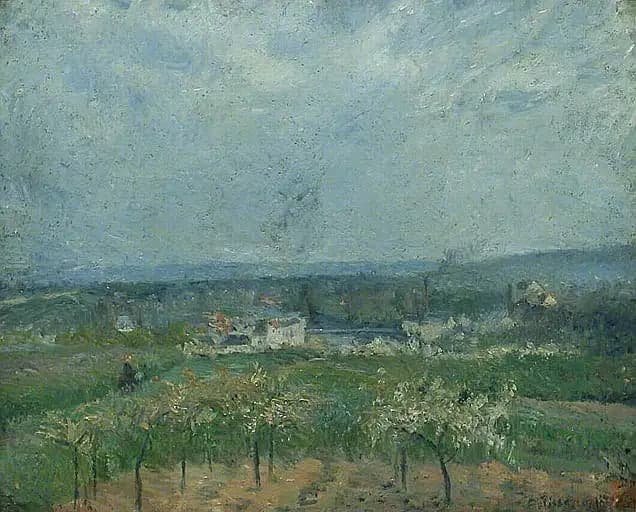
Landscape at Pontoise
- Original dimensions
- 25.2 x 17.7 cm
- Museum
- Albertina
- Year
- 1872
Scene depicted
This masterpiece presents an idyllic panorama of Pontoise, painted with the sensitivity of an attentive observer. The gentle hills blend with a cloudy sky, where light plays an essential role, transforming every detail of the landscape into a vibrant celebration of nature. The trees, the sky, and the earth seem to merge into a silent harmony, typical of Pissarro's Impressionist approach.
Historical context
Created in 1872, this painting is set in the town of Pontoise, France, within the Impressionist movement that seeks to capture the essence of light and color. At that time, Pissarro, one of the pioneers of Impressionism , explores the bucolic landscapes of his region, seeking to immortalize fleeting moments in his paintings . Today, this painting is preserved in the Albertina museum in Vienna, where it continues to fascinate art lovers from around the world.
Place in the artist's career
“Landscape at Pontoise” marks a significant milestone in the career of Camille Pissarro , reflecting his artistic maturity. Compared to “Boulevard Montmartre, Spring” (1897) and “The Potato Harvest” (1885), this painting illustrates Pissarro's progression towards bolder compositions and refined light play, while remaining deeply rooted in his love for rural landscapes.
Anecdote
“Nature is my greatest teacher, each nuance has its own whisper,” Pissarro might have said when recalling his inspirations. One spring morning, while walking along the Seine, he was enchanted by the reflections in the water and the dance of shadows on the green fields, a moment that infused his canvas with vitality.