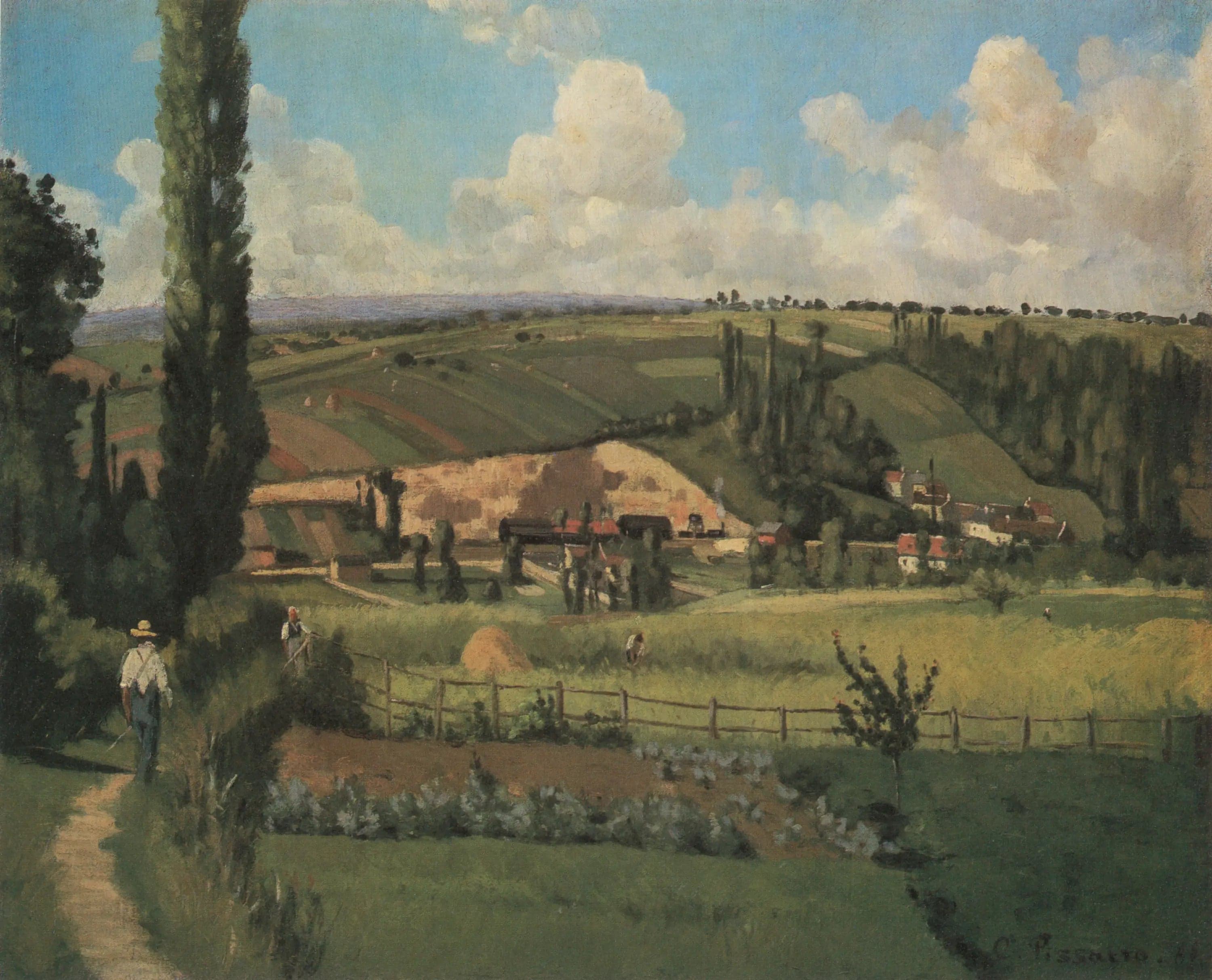
Landscape at Pâtis, Pontoise
- Original dimensions
- 100 x 81 cm
- Museum
- National Gallery of Art
- Year
- 1868
Scene depicted
In the painting “Landscape at Pâtis, Pontoise,” Camille Pissarro takes us to the heart of a soothing landscape, where lush fields meet gentle groves. The harmonious composition of the painting illustrates the serene coexistence between man and nature, offering an idyllic vision that invites contemplation. This canvas exudes an atmosphere of tranquility, inviting everyone to soak in the beauty of rural scenes.
Historical context
Created in 1868, this stunning painting embodies all the beauty of the Impressionist movement. Located in Pontoise, a charming town in the Île-de-France region, this painting reflects the bucolic landscapes that Pissarro cherished so much. The period of creation of this work is marked by a constant search for brightness and play of shadow, characteristics of Impressionism . Today, this canvas is carefully preserved at the National Gallery of Art , where visitors can admire its impressive dimensions of 100 x 81 cm.
Place in the artist's career
This painting marks a crucial step in Pissarro's career, illustrating his commitment to a deeper exploration of rural scenes. It is situated after iconic works such as “Place du Théâtre Français” and before “The Potato Harvest.” Through this painting , one feels that Pissarro has reached a level of artistically significant maturity, characterized by an increased mastery of light and color.
Anecdote
“I find beauty in the light that plays with nature, each brushstroke must be a dance between shadow and clarity.” These words, inspired by Pissarro's creative soul, evoke his passion for landscapes. Imagine a spring morning in Pontoise, where the first rays of sunlight filter through the leaves, awakening nature. It is in this enchanting setting that Pissarro drew inspiration for his masterpiece .