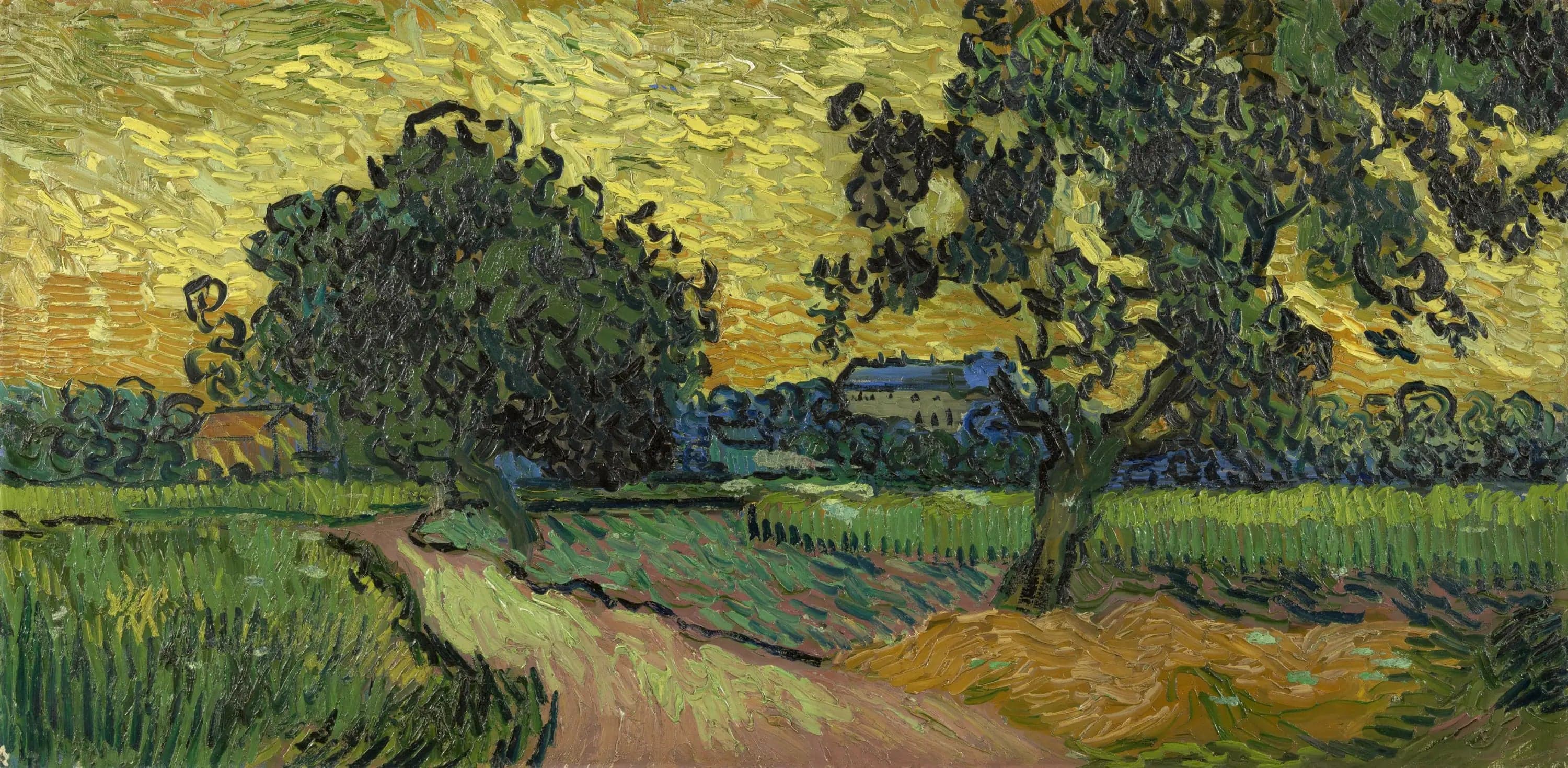
Landscape at Dusk
Scene depicted
This painting evokes a privileged moment when day gives way to night. The rays of the sun blend with the silhouettes of the trees, creating a mystical atmosphere where nature peacefully falls asleep. The composition highlights the depth of van Gogh's feelings in the face of this ephemeral moment, a resonance of calm and contemplation.
Historical context
Created in 1890, the painting Landscape at Dusk is set in the enchanting backdrop of Auvers-sur-Oise , a historic town where Vincent van Gogh completed his artistic journey. This masterpiece belongs to the post-impressionist movement, a current that captured human emotions through vibrant colors and bold forms. Currently, this painting is preserved at the Van Gogh Museum , a sanctuary for art enthusiasts. Its impressive dimensions, 107 x 50 cm, testify to the magnitude of this pictorial work.
Place in the artist's career
Landscape at Dusk represents a stylistic peak in the career of Vincent van Gogh , at a time when his style is refining and his vision of the world is clarifying. Comparatively, works like The Starry Night and The Sunflowers illustrate the evolution of his techniques, his commitment to raw emotions, and his desire to translate the beauty of fleeting moments.
Anecdote
“The light of dusk inspires me with infinite depth,” van Gogh once said, anchoring his feeling in the changing nature. It was on a quiet evening, as the sky was tinted with shades of gold and blue, that he found inspiration for this masterpiece . Each brushstroke resonates with this original emotion, blending with the evocative power of Landscape at Dusk .