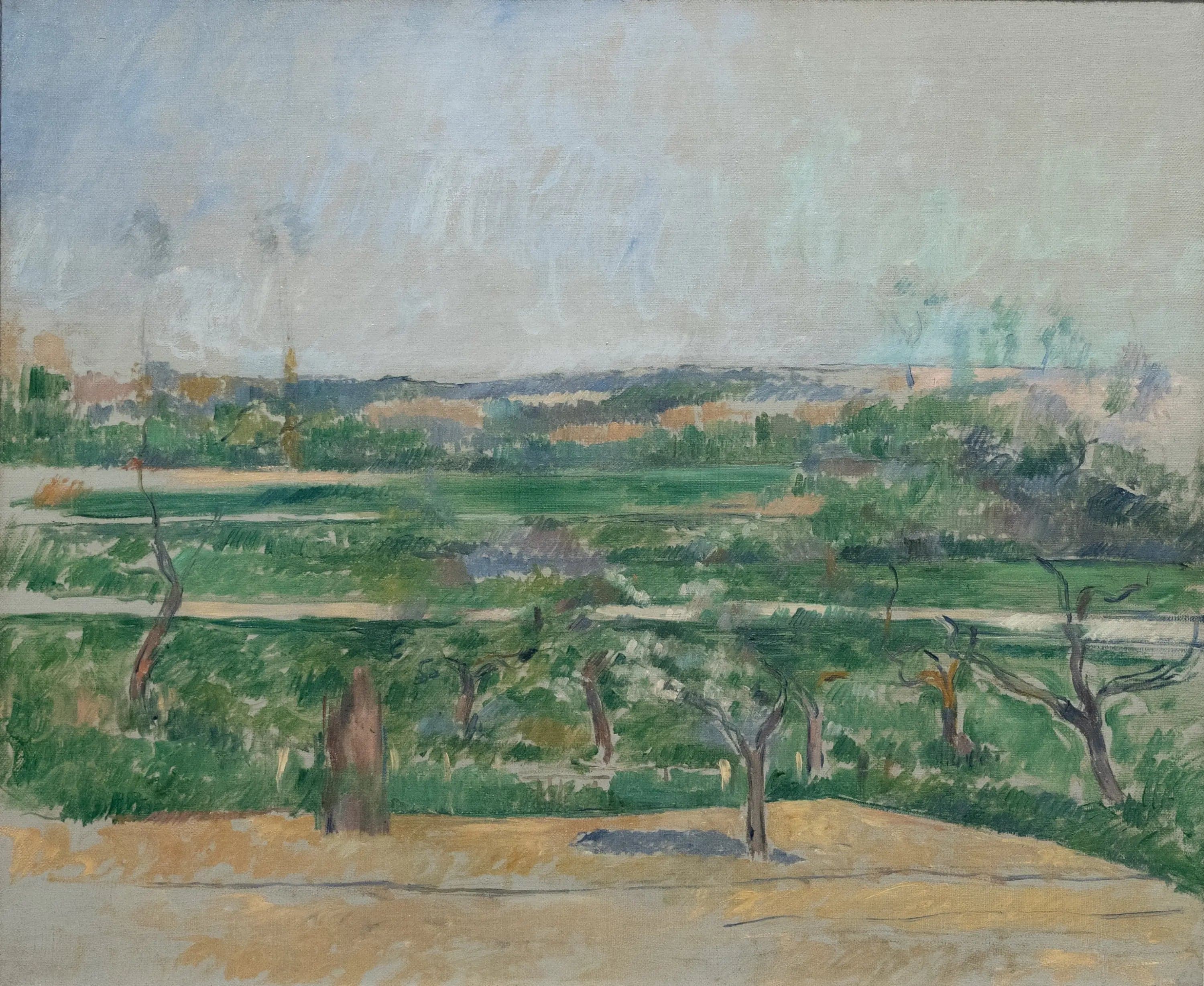
Landscape at Aix-en-Provence
- Original dimensions
- 55.3 x 46 cm
- Museum
- Wallraf-Richartz Museum
- Year
- 1879
Scene depicted
The painting “Landscape in Aix-en-Provence” reveals a panorama where the winding lines of the hills blend with lavender fields, bathing everything in warm light. Cézanne, with his distinctive touch, presents a harmonious composition that evokes the tranquility and ephemeral beauty of nature. The colors intertwine, representing the juxtaposition of the joy of the sky and the earthly fullness, drawing us into a captivating visual quest.
Historical context
Created in 1879, this painting is set in the intoxicating landscape of Aix-en-Provence, in the heart of French Provence. A famous representative of post-impressionism , Cézanne captures here the golden light and vibrant shadows of his native region. The canvas , now exhibited at the Wallraf-Richartz Museum , measures 55.3 x 46 cm and bears witness to the ease of a time when art began to free itself from academic traditions.
Place in the artist's career
This painting is situated at a pivotal moment in Cézanne's career, illustrating his transition to more abstract forms. Also to discover are “The Large Bathers” and “Mont Sainte-Victoire,” other canvases that together trace his unique artistic evolution, marked by the relentless search for depth and expression.
Anecdote
“Nature is my only mistress,” Cézanne reportedly declared one day while contemplating the hills of his town. Inspired by a sunny morning when the scents of the garrigue floated in the air, he threw himself onto his canvas to immortalize this scene of serenity. Thus was born this masterpiece , where the simple beauty of a landscape becomes a timeless experience.