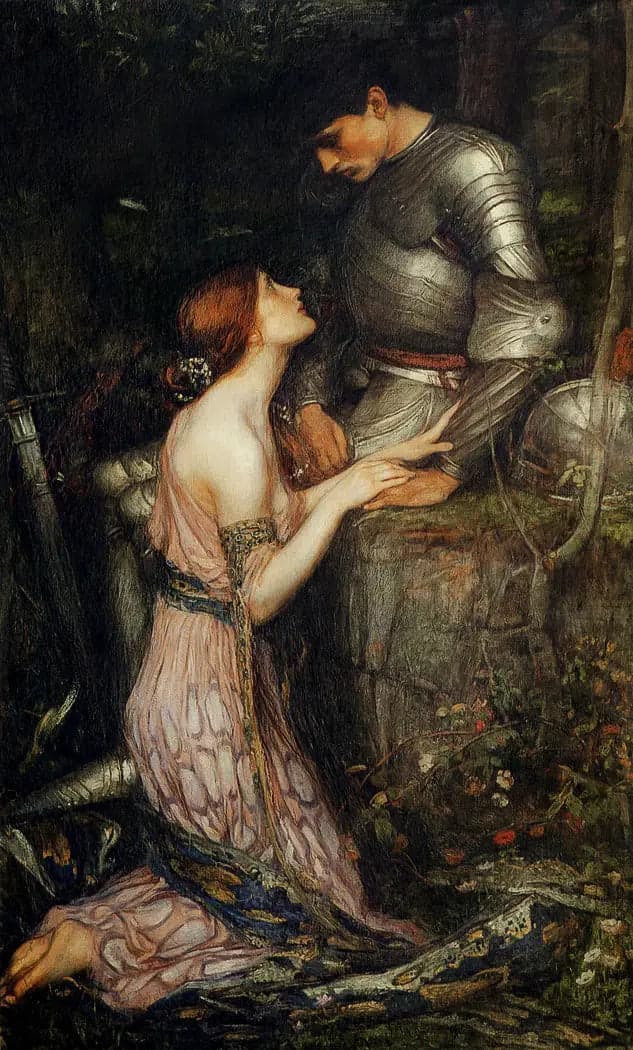
Lamia and the Soldier
Scene depicted
In this canvas , Lamia, a mythological creature, embraces a soldier, symbolizing the tension between passion and obligation. The soldier's sorrowful gaze, imbued with silent pain, contrasts with Lamia's tenderness, creating an atmosphere charged with complex emotions. The painting thus becomes a visual narrative where love meets despair, a dance between light and shadow.
Historical context
Created in 1905, this painting is part of the Pre-Raphaelite movement, within a flourishing artistic context in London, England. John William Waterhouse , a renowned artist, was able to capture the essence of his time, combining romanticism and symbolism . Currently, this canvas belongs to a private collection, testifying to the timeless success of this pictorial work, whose dimensions are 61 x 91 cm.
Place in the artist's career
This painting represents a key period in Waterhouse's career, a stylistic peak where his genius fully expresses itself. Like the canvas “Sleeping Beauty” and “The Lady of Shalott,” one can observe an evolution in his use of light and the theme of tragic love. These works share the same aesthetic vibration, a common thread of shadows and lights that illuminate the souls of the characters.
Anecdote
“Beauty flourishes in the ephemeral,” said Waterhouse. Inspired by a gentle spring morning, he wandered through the streets of London, a breath of orange blossom mingled with the fresh air. This painting , at the crossroads, captures this fleetingness, evoking a poignant reflection on love and sacrifice.