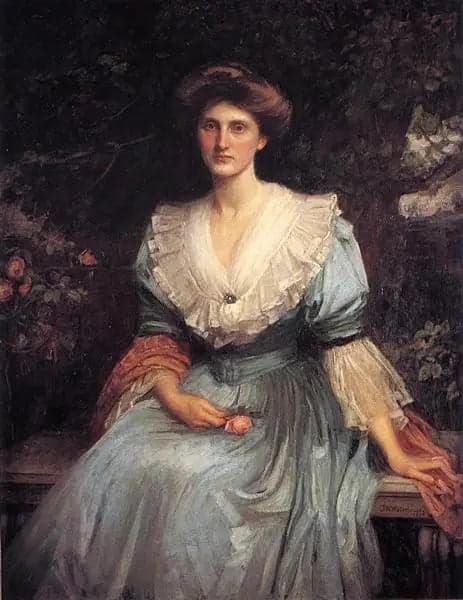
Lady Violet Henderson
Scene depicted
"Lady Violet Henderson" depicts a woman dressed in a blue velvet gown, standing in a lush garden. Surrounded by vibrant flowers, she seems to contemplate the world with a gaze that is both melancholic and serene. This composition comes to life through a silent dialogue between the woman and her environment, capturing the essence of femininity and the ephemeral beauty of nature.
Historical context
Created in 1898, the painting "Lady Violet Henderson" is part of the Pre-Raphaelite movement, an artistic trend dominating Victorian England. In the vibrant city of London, Waterhouse brought this iconic work to life, illustrating the timeless beauty and emotional depth that characterize his art. Currently, this canvas is housed at the Seattle Art Museum in the United States, measuring 91 by 61 centimeters.
Place in the artist's career
This painting represents a stylistic peak in Waterhouse's career, reflecting his mature approach to the feminine theme. Alongside "The Lady of Shalott" and "Ophelia," "Lady Violet Henderson" testifies to the evolution of his work, particularly through the use of light and color, giving a new emotional dimension to the canvas .
Anecdote
Waterhouse had a penchant for nature and intimacy. He said: "Every canvas is a beating heart, a life to discover." It was on a spring morning while he wandered through the gardens of Kensington that the idea for this painting came to him, emerging from the soft light and floral fragrances surrounding him, inspiring the evocative strength of this pictorial work .