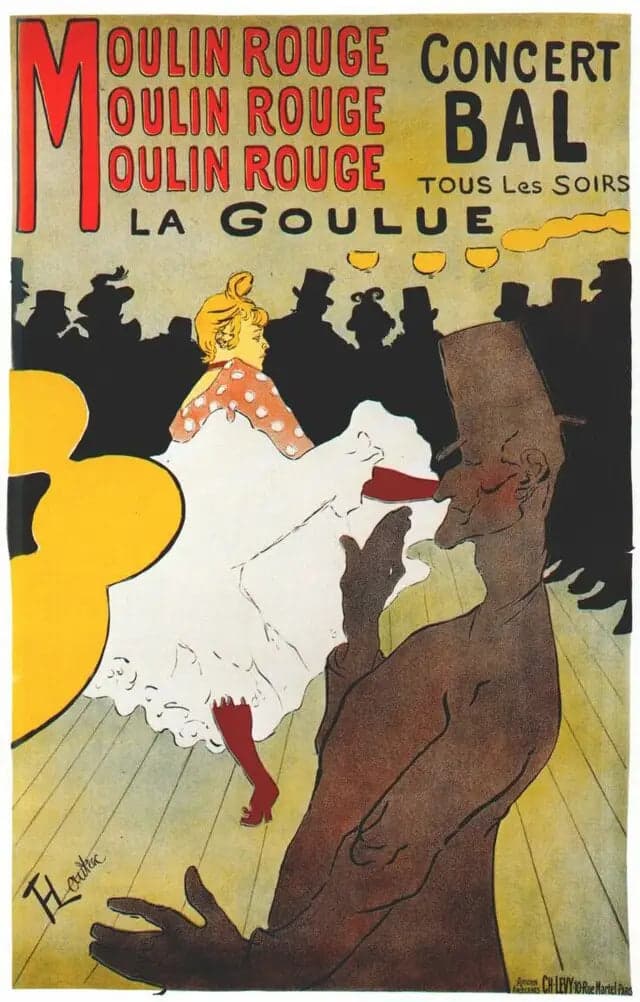
La Goulue in Almée - Henri de Toulouse
- Original dimensions
- 48.5 x 68.5 cm
- Museum
- Not specified
- Year
- 1895
Scene depicted
The canvas “La Goulue en Almée” features the famous star dancer, Louise Weber, nicknamed “La Goulue,” dazzling in her posture and flamboyant character. At the heart of the Moulin Rouge, the painting captures the energy and joy of life of this era. With her grace and charm, La Goulue attracts attention, a vibrant representation of Parisian pleasures, illuminated by the art of Toulouse-Lautrec.
Historical context
Created in 1895, this painting emblematic will be born in the vibrant setting of Montmartre, a Parisian district that embodies the artistic effervescence of the Belle Époque. The work belongs to the post-impressionist movement, known for its boldness and innovation. It illustrates not only the magic of cabarets but also bears witness to a time when the explosive creativity of art mingled with the nocturnal pleasures of Paris. Currently, the canvas is preserved in a private collection, enhancing its aura of mystery.
Place in the artist's career
This painting occupies a prominent place in Lautrec's artistic evolution, representing a period when he merges his illustration techniques with a bold pictorial style. At the same time, works like “L'Absinthe” and “Au Moulin Rouge” show this same melancholy, his reflections on the human condition through a sharp gaze on society. “La Goulue en Almée” is a perfect marriage of happiness and sadness, a stylistic peak of his career.
Anecdote
“I paint the world as I see it, much more than a simple reflection, an emotion to capture.” This whisper from Lautrec evokes the genesis of his masterpiece . Imagine a sunny spring morning, in a bustling alley, where the clamor of laughter and the music of accordions mingle. It is this sensory climate that nourishes the soul of the painting , making each brushstroke alive with intensity.