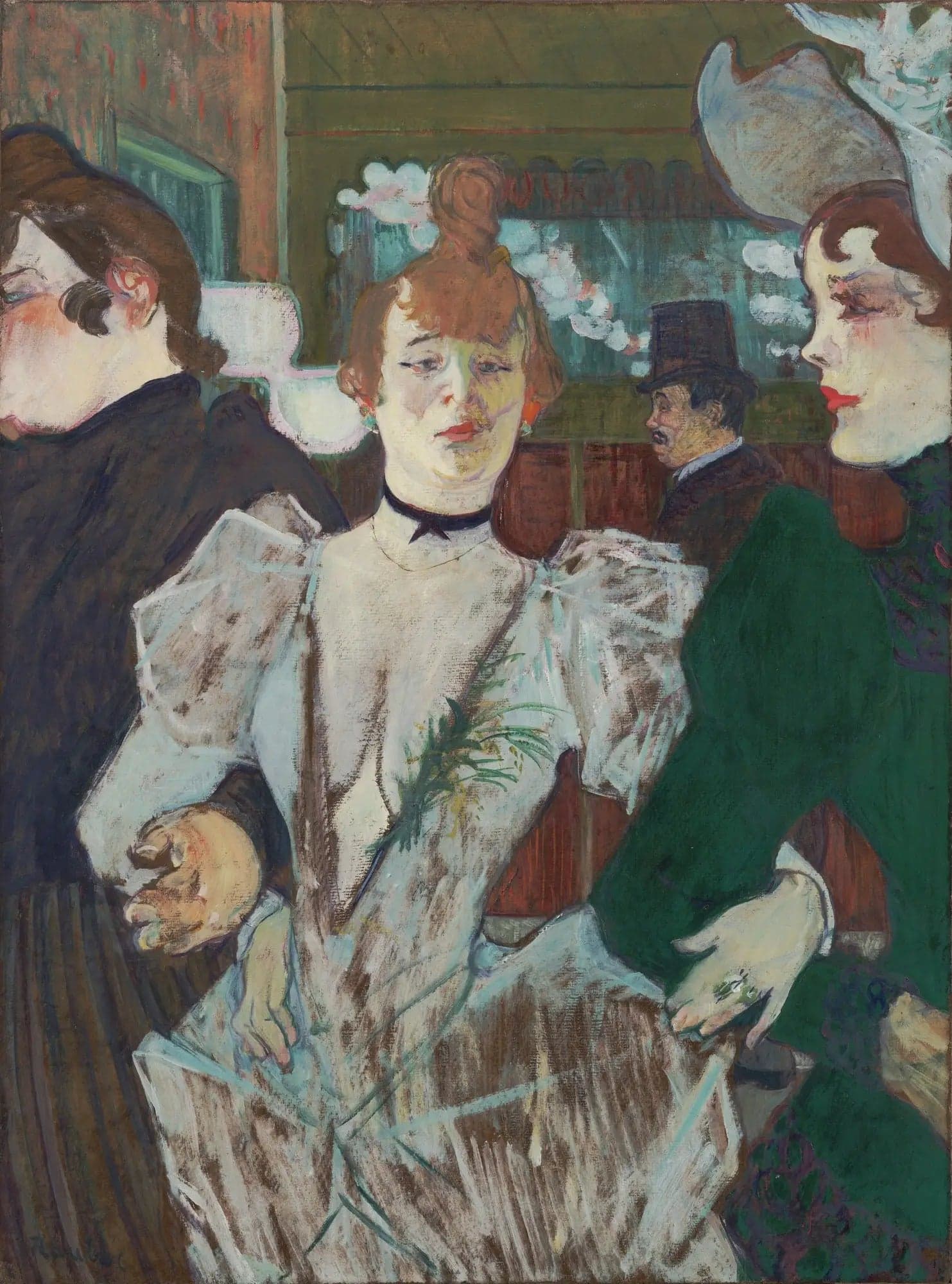
La Goulue entering the Moulin-Rouge - Henri de Toulouse
- Original dimensions
- 59 x 79.4 cm
- Movement
- post-impressionism
- Museum
- Museum of Modern Art
Scene depicted
This painting depicts the flamboyant entrance of La Goulue, the famous cancan dancer, into the renowned Moulin-Rouge. Her voluptuous silhouette, splashed with bright colors, catches the eye while the world around her comes to life. The spectators, enchanted by her ability to captivate the audience, are in ecstasy, and the painting becomes a mirror of an era with its unalterable energy.
Historical context
Painted in Paris at the end of the 19th century, La Goulue entering the Moulin-Rouge is an emblematic work of the post impressionist movement. The painting stands out for its electric atmosphere, typical of the excitement of Parisian nights. Currently exhibited at the Museum of Modern Art, this masterpiece by Toulouse-Lautrec invites us to relive the magic of a time when the cabaret became the symbol of a flourishing culture.
Place in the artist's career
La Goulue entering the Moulin-Rouge represents a turning point in Toulouse-Lautrec's career, a maturation of his style where the energy of the cabaret merges with a refined technique. Alongside Jane Avril and At the Moulin-Rouge , this painting illustrates his skill in capturing not only the form but also the spirit of nightlife, exploiting light and color to evoke the vibrancy of iconic places.
Anecdote
Henri de Toulouse-Lautrec often said: "I paint people to capture the moment, to seize the soul of the party. Each canvas is a breath of life." It was in the intoxication of a Parisian night, surrounded by musicians and dancers, that he found inspiration for this vibrant painting . La Goulue , an icon of wild evenings, slips into the Moulin-Rouge, illuminated by the sparkling lights, creating an ineffable and captivating moment.