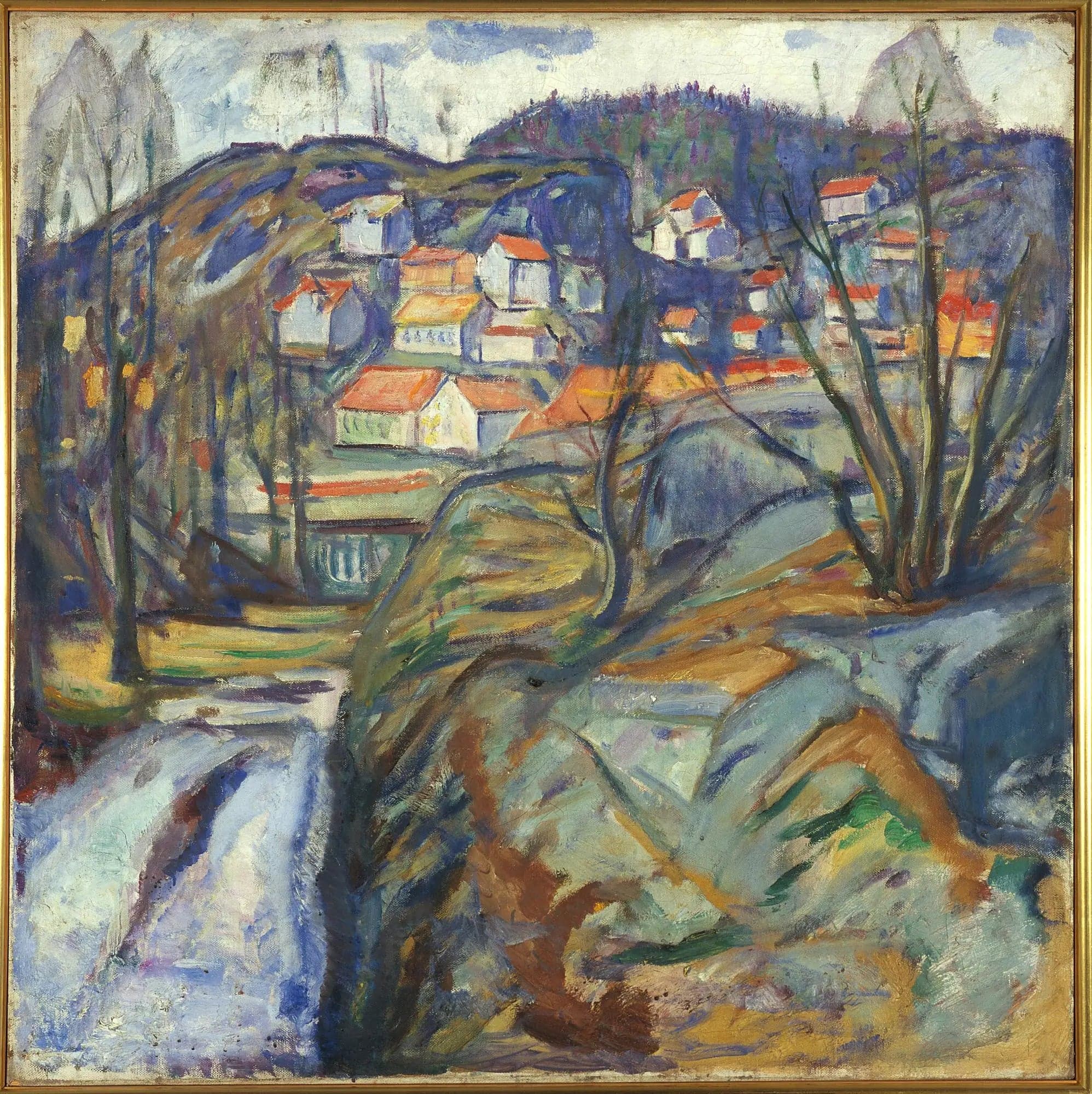
Kragerø in Spring
- Original dimensions
- 45.3 x 55 cm
- Museum
- Harvard Art Museums
- Year
- 1910
Scene depicted
This painting offers a poetic vision of Kragerø, immersed in soft spring light. The artist captures seascapes and hillside dwellings, bathing in a universe of shimmering colors. The harmonious composition reveals a peaceful location, where the viewer is invited to feel the warmth of the sun and the whisper of the waves. The gaze unfolds into the distance, immersing itself in an ocean of sensations.
Historical context
The year 1910, marked by artistic and cultural upheavals, sees the creation of the iconic painting Kragerø in spring by Edvard Munch . Created in the picturesque town of Kragerø, Norway, this canvas is at the heart of the expressionist movement, a current that seeks to capture raw emotions and deep feelings. Currently exhibited at the Harvard Art Museums , this painting with compact dimensions constitutes a true journey through time and space.
Place in the artist's career
The painting Kragerø in spring is part of a period of maturity for Munch. Previously known for powerfully emotional works like The Scream and The Madonna , this painting reflects an evolution towards an expression of gentleness and serenity. In parallel, his works The Dance of Death and The Gaze into the Unknown capture intensity and melancholy, contrasting with the warm light of this composition.
Anecdote
“Nature is a love song to light and the seasons. It is spring that returns, and I can only marvel.” These words, attributed to Munch, evoke the magic of a spring morning, the fragrant paths of blooming flowers, and the vibrant colors of nature. It is precisely this feeling of wonder and serenity that one experiences when contemplating the masterpiece Kragerø in spring .