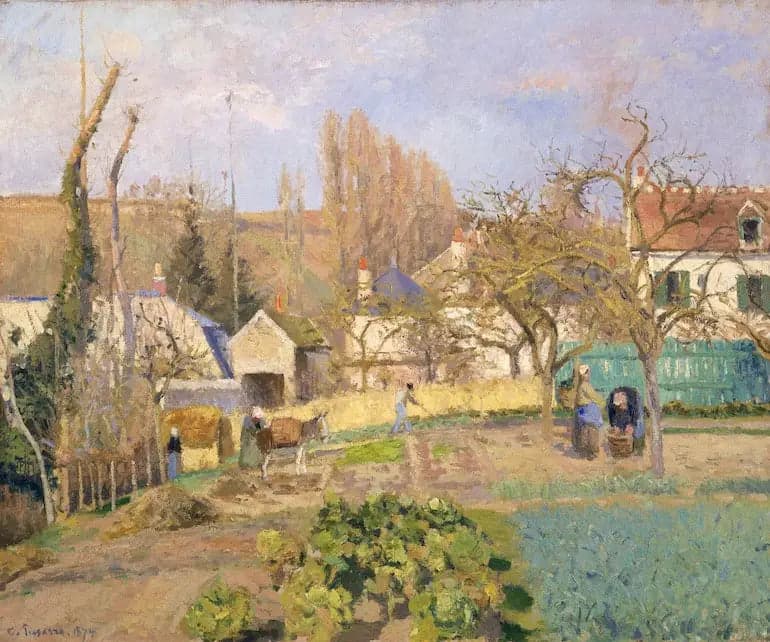
Kitchen Gardens of L'Hermitage, Pontoise
- Original dimensions
- 65.1 x 54 cm
- Museum
- National Gallery of Scotland
- Year
- 1874
Scene depicted
In this work, Pissarro immerses us in the lush gardens of L'Hermitage, revealing the simplicity of rural life during the Impressionist era. The verdant hues and bursts of light emanating from this canvas evoke the tranquility of a sunny morning, where every detail is highlighted, every shadow revealed, adding to the narrative richness of the pictorial work.
Historical context
Created in 1874, this painting is an iconic work of the Impressionist movement set in the bucolic surroundings of Pontoise, a town that has seen the birth of many masterpieces. Camille Pissarro , a major figure of Impressionism , managed to capture the essence of nature through his canvas , now preserved at the National Gallery of Scotland. This painting belongs to a period when art sought to break free from conventions, to better immortalize light and everyday life.
Place in the artist's career
The painting “Potagers de L'Hermitage, Pontoise” represents a crucial step in Pissarro's career, at the dawn of his full maturity. Positioned among other significant works like “The Hay Harvest” and “Boulevard Montmartre, Spring,” it marks a technical evolution towards more vibrant textures and bold plays of light, revealing the unifying talent of the artist within his time.
Anecdote
“Nature is a masterpiece; one must know how to immerse one's gaze in it to grasp its magic,” Pissarro might have said while contemplating the gardens that surrounded him in the early morning. This fleeting moment, where the dew sparkles on the vegetables, inspired a painting that speaks with extraordinary evocative power, the very essence of his pictorial composition .