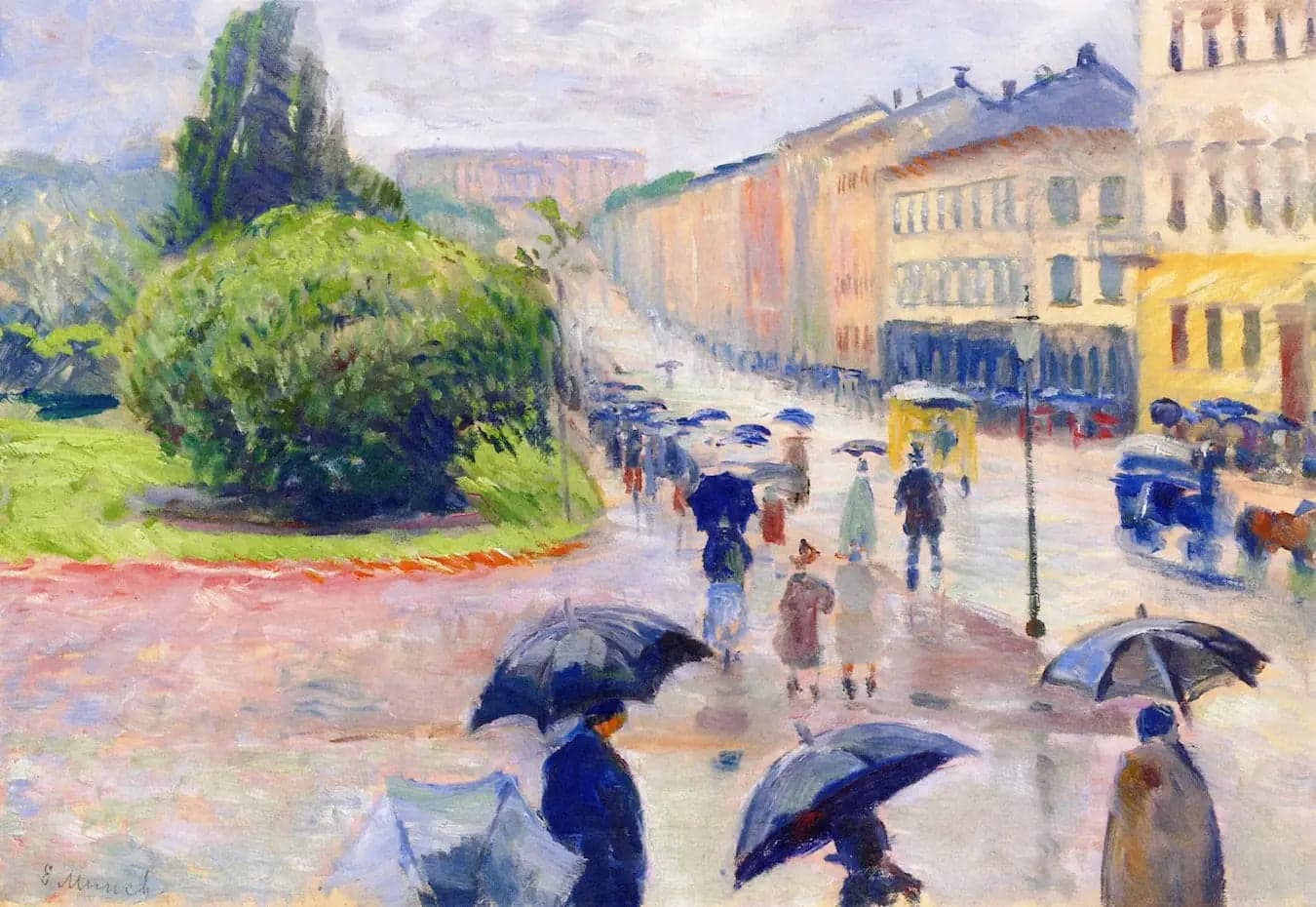
Karl Johan in the Rain
- Original dimensions
- 55 x 38 cm
- Museum
- Munch Museum
- Year
- 1891
Scene depicted
In this painting , Munch depicts a solitary figure making their way through a pouring rain, the shining cobblestones of Karl Johan Avenue, emblematic of the city. The painting illustrates the duality of human existence: the struggle against the elements and isolation in the midst of a crowd. Each drop of rain seems to strike the soul, awakening universal emotions of nostalgia and reflection.
Historical context
Created in 1891, this painting emanates from the artistic effervescence of Oslo, the capital of Norway, within the emerging expressionist movement. In a context where the city was modernizing while preserving a rich cultural past, the painting "Karl Johan under the rain" captures an urban scene imbued with melancholy. Currently housed in the Munch Museum, this canvas reflects the tensions between nature and man, with dimensions that enhance its visual impact.
Place in the artist's career
"Karl Johan under the rain" marks a pivotal moment in Munch's career, signifying his transition to artistic maturity. A pioneer of expressionism , this canvas dialogues with other works such as "The Scream" and "The Dance of Life," illustrating his evolution towards a more emotional and subjective representation of reality.
Anecdote
Edvard Munch once expressed: "The rain is the melody of the world and each drop a note of pain." As he walked through the rainy alleys of Oslo, a rare break in the clouds slipped between two downpours. This pictorial work , a product of emotions captured in a moment, reflects the evocative power of his thoughts and inner universe.