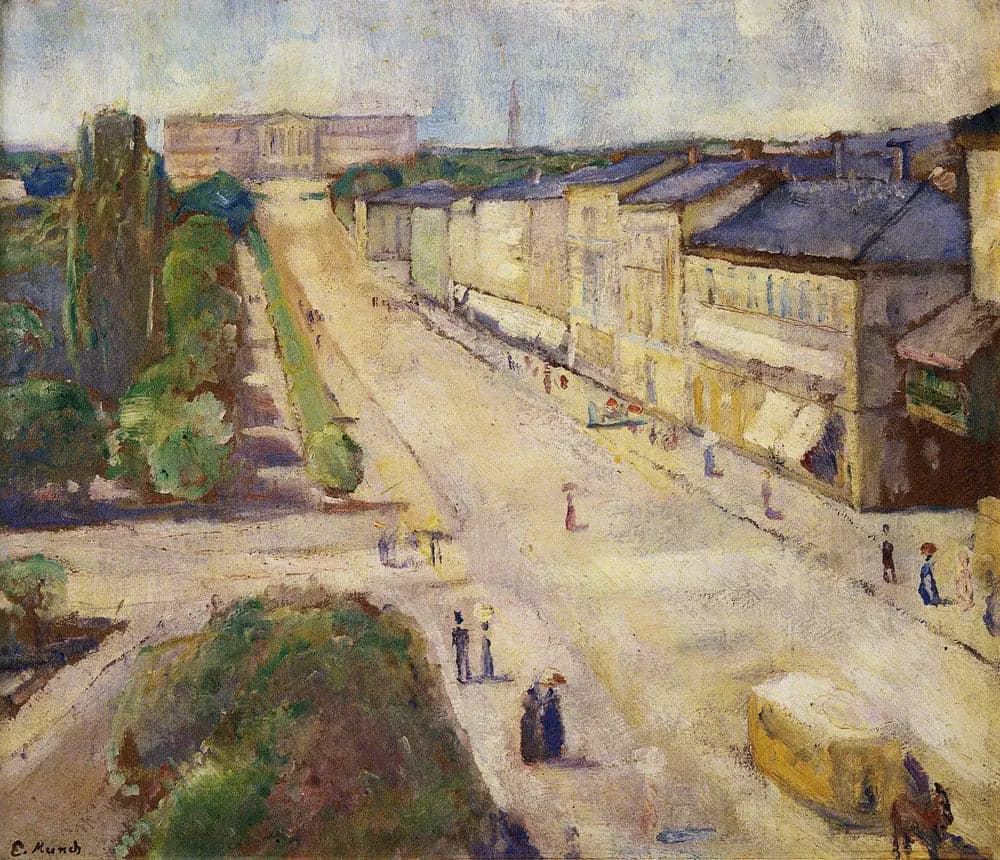
Karl Johan
- Original dimensions
- 82 x 51 cm
- Museum
- Munch Museum
- Year
- 1889
Scene depicted
The painting "Karl Johan" highlights a scene imbued with melancholy, where one perceives a man walking with a hesitant step, enveloped by the gray atmosphere of a gloomy Oslo. This suspended moment, representing the sovereign Karl Johan, sympathizes with feelings of solitude, quest, and hope. Munch succeeds in capturing the essence of a moment, making this canvas a reflection of the internal tensions of individuals facing society.
Historical context
Created in 1889 in Oslo, the painting "Karl Johan" represents a period of intense creativity in the career of Edvard Munch , a master of the Expressionist movement. At that time, the artistic world was undergoing a radical transformation, marked by a quest for sincere emotions. The work is now carefully preserved in the Munch Museum, ready to engage with those who admire its genius. Its dimensions, 82 x 51 cm, give this canvas an intimate and evocative presence.
Place in the artist's career
"Karl Johan" represents a turning point in the career of Edvard Munch , consolidating his status as a pioneer in the expressionist movement. Alongside his other masterpieces, such as "The Scream" and "The Madonna," this painting illustrates a bold choice of colors and forms that define his unique style and highlight his existential concerns. It is during this period that the artist truly asserts his voice, distancing himself from the conventions of the past.
Anecdote
Edvard Munch once said: "The painting is a cry of the soul, an emulsion of life." This cry resonates deeply in "Karl Johan," a pictorial work inspired by a winter morning, where a familiar face in a quiet street left an indelible mark in his memory. The painting will translate this poignant emotion into a subtly reflective composition.