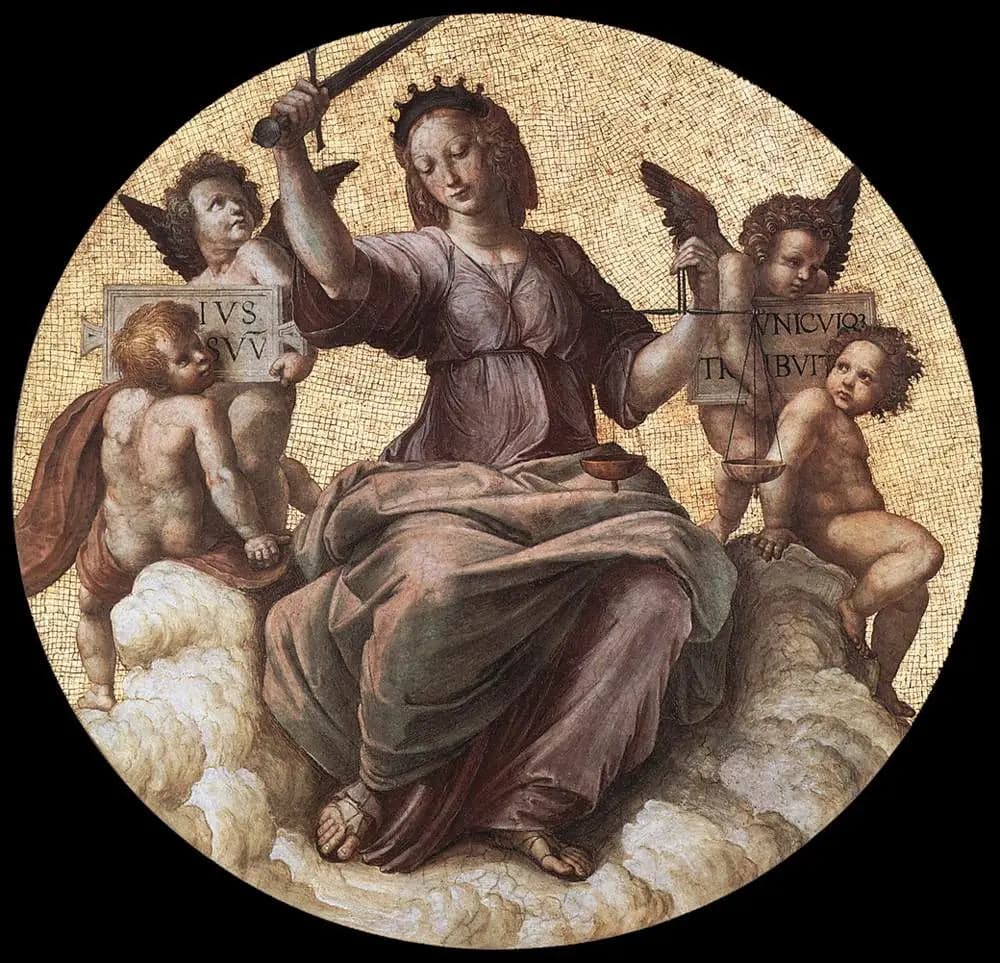
Justice
- Original dimensions
- 180 x 180 cm
- Movement
- High Renaissance
- Museum
- Vatican museums
- Year
- 1508
Scene depicted
The painting "Justice - Raphaël Sanzio" evokes a key moment of the human condition, where virtue and equity come to life through a composition rich in symbols. In this pictorial work , the figure of Justice is represented, astronaut of harmony, her attributes revealing the tension between law and morality. The interior unfolds around a scene where each character, each gesture plays an essential role in embodying a universal ideal, resonating deeply with viewers across the ages.
Historical context
Created in 1508, this painting is an emblematic beacon of artistic genius located in the heart of Rome, the cradle of the High Renaissance . The canvas shines with its historical brilliance, offering a glimpse into an era where harmony and beauty were cardinal values. Currently housed in the prestigious Vatican museums , this pictorial work sublimely meets history and art, measuring its greatness by its imposing dimensions of 180 x 180 cm.
Place in the artist's career
This painting marks a decisive turning point in Raphael's career, marking his artistic peak. Similar to other paintings like "The School of Athens" and "The Sistine Madonna," "Justice" illustrates an evolution marked by an increasingly assertive technical mastery, where the psychological depth of the characters increases while firmly anchoring itself in a classical aesthetic of the High Renaissance .
Anecdote
Raphael, in one of his reflections, reportedly shared: "Art is the truth given to the eye." This quote resonates in his creative process, awakening his inspiration on a spring morning in Rome, wandering through sunlit alleys, where every shadow and every ray of sunlight echoed like promises of eternal beauty. It is this quest for accuracy and light that is expressed with intensity in this painting .