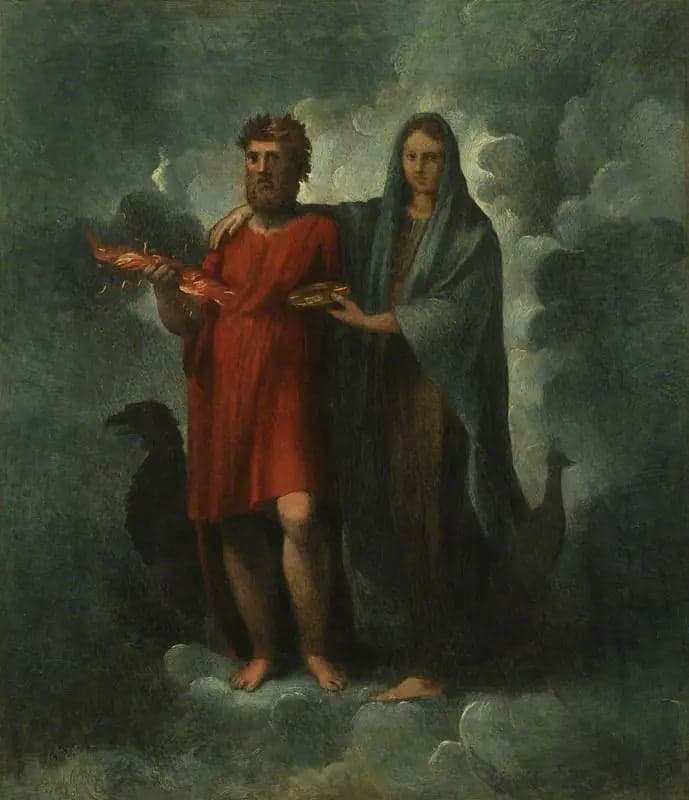
Jupiter and Juno
- Original dimensions
- 36.5 x 42.3 cm
- Museum
- Christ Church
Scene depicted
The painting "Jupiter et Junon" magnificently illustrates Roman mythology. This masterpiece features Jupiter, lord of Olympus, alongside Juno, goddess of marriage and protector of women. Their sublime interaction conveys the conflicts and passions of their tumultuous relationship, while exuding an aura of royalty and authority. The composition of this painting unfolds a harmony of movements, rhythmically punctuated by the gestures of the iconic characters, evoking ancient tales that resonate through the ages.
Historical context
Created in the early 16th century, this painting is emblematic of the high artistic renewal of the Italian Renaissance . Located in Oxford, in the prestigious Christ Church museum, this canvas bears witness to the peak of master Raphael Sanzio, whose style merges avant-garde and classicism. The integrity of his technique and the fluidity of his compositions continue today to dazzle and enchant art enthusiasts.
Place in the artist's career
"Jupiter et Junon" is positioned at a pivotal moment in Raphael's career, revealing his artistic maturity. At this time, the artist subtly combines realism and idealism. Compared to other paintings such as "The Sistine Madonna" and "The School of Athens," this painting illustrates the technical evolution of the artist, capturing light and color from a new perspective, while reinforcing his status as a genius of the Renaissance .
Anecdote
It is said that Raphael, at the dawn of a spring day, soaked in the soft light filtering through an old stained glass window. "The soul of each masterpiece resides in the light that passes through it," he would have murmured, his hand brushing against the sketches of what would become the essential painting "Jupiter et Junon." This fleeting moment injected new life into this painting , capturing eternity through vibrant mythological figures.