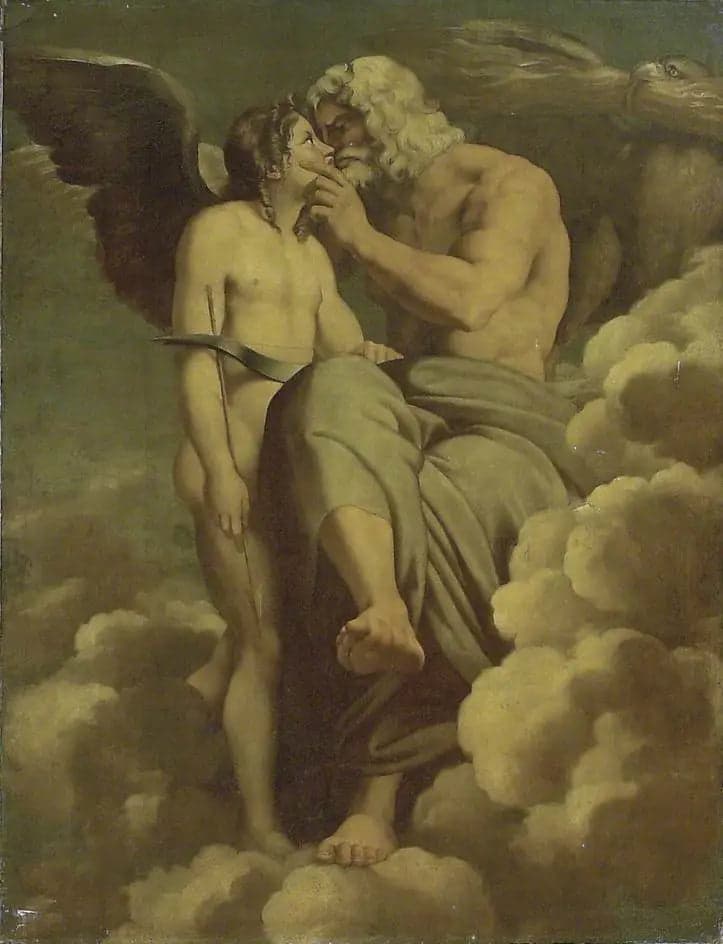
Jupiter and Cupid
- Original dimensions
- 152.3 x 195.7 cm
- Museum
- Ashmolean Museum
- Year
- 1700
Scene depicted
The painting Jupiter et Cupidon illustrates a poignant mythological scene where Jupiter, the king of the gods, leans over his son Cupid. The soft light caresses the faces, while narrative elements, such as the laurel crown and arrows, bring a symbolic depth. Every detail, from the draping of the garments to the expressions of the characters, makes this composition a true immersion into a world of feelings and legends.
Historical context
Created at the end of the 17th century, Jupiter et Cupidon embodies the peak of romantic classicism in Florence, the cradle of the Renaissance . The painting, a striking example of the harmony of forms and colors, is currently located at the prestigious Ashmolean Museum in Oxford, United Kingdom. Its imposing dimensions captivate the gaze, this canvas fits into a context where emotion and mythology merge on the canvas, thus revealing the essence of an era.
Place in the artist's career
Jupiter et Cupidon reflects a key moment in Raphael's career, testifying to his artistic maturity. Compared to works such as The Sistine Madonna and Pope Julius II , this painting illustrates the transition from an elegant style to a deeper exploration of human emotions. Raphael's evolution is expressed here, both through the richness of colors and the complexity of poses.
Anecdote
“Art is a dialogue between the soul and the world,” Raphael might have said as he contemplated the beauty of a golden sky at dawn. Inspired by nature, each brushstroke on the canvas tells a story. Jupiter et Cupidon is no exception: it combines the intimacy of a divine relationship with the grandeur of Olympus. This pictorial work is a true ode to paternal love.