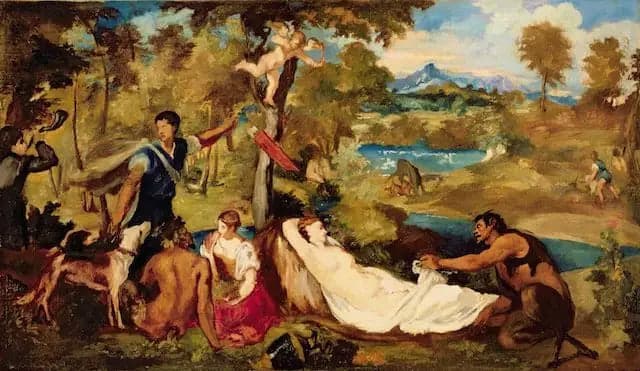
Jupiter and Antiope
- Original dimensions
- 85 x 47 cm
- Museum
- Marmottan Monet Museum
- Year
- 1856
Scene depicted
The composition of Jupiter et Antiope evokes a timeless mythology where Jupiter, the king of the gods, seduces Antiope, a mortal. The intensity of the gazes and the delicacy of the movements convey a troubling passion. This canvas seems to freeze a moment that is both sensual and tragic, where the divine meets the profane in an eternal dance of desire and power.
Historical context
Created in 1856, this painting masterfully takes place in the heart of Paris, an iconic city of the Impressionist movement that begins to challenge artistic conventions. Jupiter et Antiope is fully inscribed in an era where the beauty of human forms is celebrated, and its presence at the Marmottan Monet Museum makes it an invaluable testimony of a golden age of the artistic landscape.
Place in the artist's career
This work, situated at a crucial crossroads in Manet's career, reveals his transition to an artistic maturity full of nuances. In parallel with masterpieces such as Déjeuner sur l'herbe and Olympia , Jupiter et Antiope allows us to observe a technical evolution where the painting becomes bolder, breaking conventions with expressive gestures and Impressionist light.
Anecdote
Édouard Manet reportedly stated: "The canvas must vibrate like life itself." One spring morning, while observing the shimmering reflection of light on the water, he was struck by the idea of capturing this disarming passion, transforming the painting into a vibrant sensory experience. Each brushstroke in Jupiter et Antiope seems to draw inspiration from this revelation.