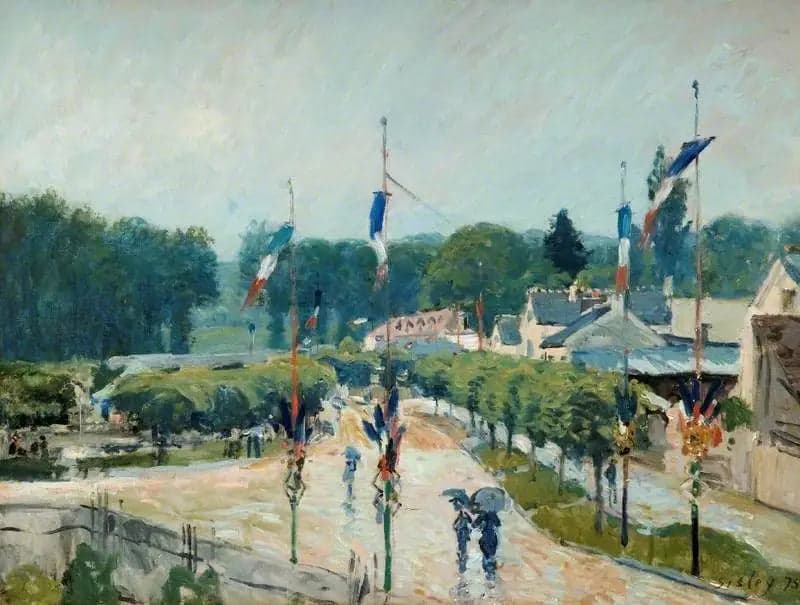
July 14th at Marly
- Original dimensions
- 72.3 x 52.5 cm
- Museum
- The Higgins Art Gallery & Museum
- Year
- 1875
Scene depicted
The painting The 14th of July in Marly reveals a festive scene where the people gather to celebrate the storming of the Bastille, a symbol of a nascent revolution. Sisley, with his poetic gaze, illustrates the joyful and festive spirit that emanates from the celebration, while the surrounding nature awakens in a vibrant breath. Joyful individuals, enveloped in an idyllic setting, convey an atmosphere of conviviality and hope.
Historical context
Created in 1875, the painting The 14th of July in Marly finds its inspiration in the heart of France, in the charming town of Marly-le-Roi, located not far from Paris. This iconic work is of great importance within the Impressionist movement, brilliantly embodying the quest of painters of that time to capture the light and movement of everyday life. Today, this canvas is housed at The Higgins Art Gallery & Museum, where it is admired for its vibrant representation of the Parisian world. Its dimensions, 72.3 x 52.5 cm, invite intimate and immersive contemplation.
Place in the artist's career
In the career of Alfred Sisley , The 14th of July in Marly occupies a prominent place, representing a pivotal period where the artist stands out in the Impressionist circle. Compared to his works The Bridge of Moret on the Loing and The Banks of the Seine at Argenteuil , one observes an evolution in the use of light and emotions, making this painting a striking example of his stylistic peak.
Anecdote
“The light in Marly is an embrace that only a tree can offer.” By evoking these words, one can imagine Alfred Sisley wandering through the flowered paths at sunrise, inspired by the play of shadow and light dancing on the water. The painting The 14th of July in Marly is the result of moments of wonder in the face of nature, a canvas where each brushstroke tells a vibrant story.