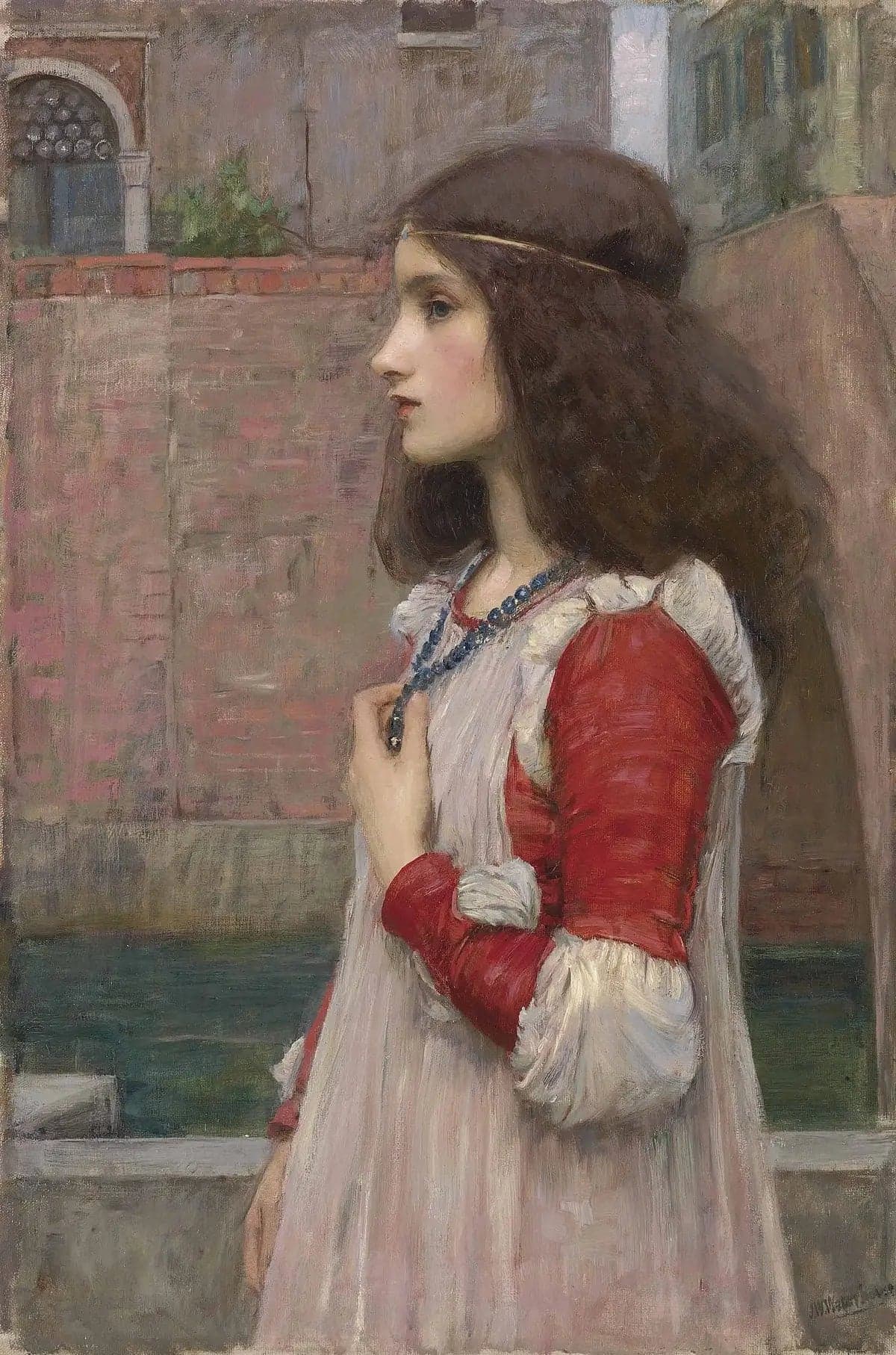
Juliet
Scene depicted
The painting “Juliette - John William Waterhouse ” depicts the famous heroine of Shakespeare's romantic tragedy. The young woman, dressed in a delicate gown, seems to passionately await her lover in a lush garden. The vivid colors of this painting evoke feelings of desire and anticipation, each meticulous detail seeming to whisper forbidden promises.
Historical context
Created in 1898, in the artistic city of London, this painting is emblematic of the Pre-Raphaelite movement, where romanticism and symbolism intertwine. At that time, England rediscovered itself through a vision of art full of colors, inspired by the timeless beauty of nature and mythological tales. Currently, the canvas is in a private collection, attesting to its rarity and immense value, measuring 91 cm by 61 cm.
Place in the artist's career
This painting is situated at a notable turning point in Waterhouse's career, where he asserts his distinctive style, blending sensitivity and technique. Compared to his works “Ophelia” and “The Lady of Shalott,” where the bright light immerses the viewer in melancholy, “Juliette” marks an evolution towards a more intense feeling, capturing the essence of tragic love.
Anecdote
“In every face, there is a story of love and nostalgia.” This quote, a reflection of Waterhouse's spirit, resonates powerfully through his canvas Juliette. Inspired one bright morning while strolling through a garden filled with fragrant flowers, the artist captured the innocence and passion hidden behind the smile of an ephemeral muse.