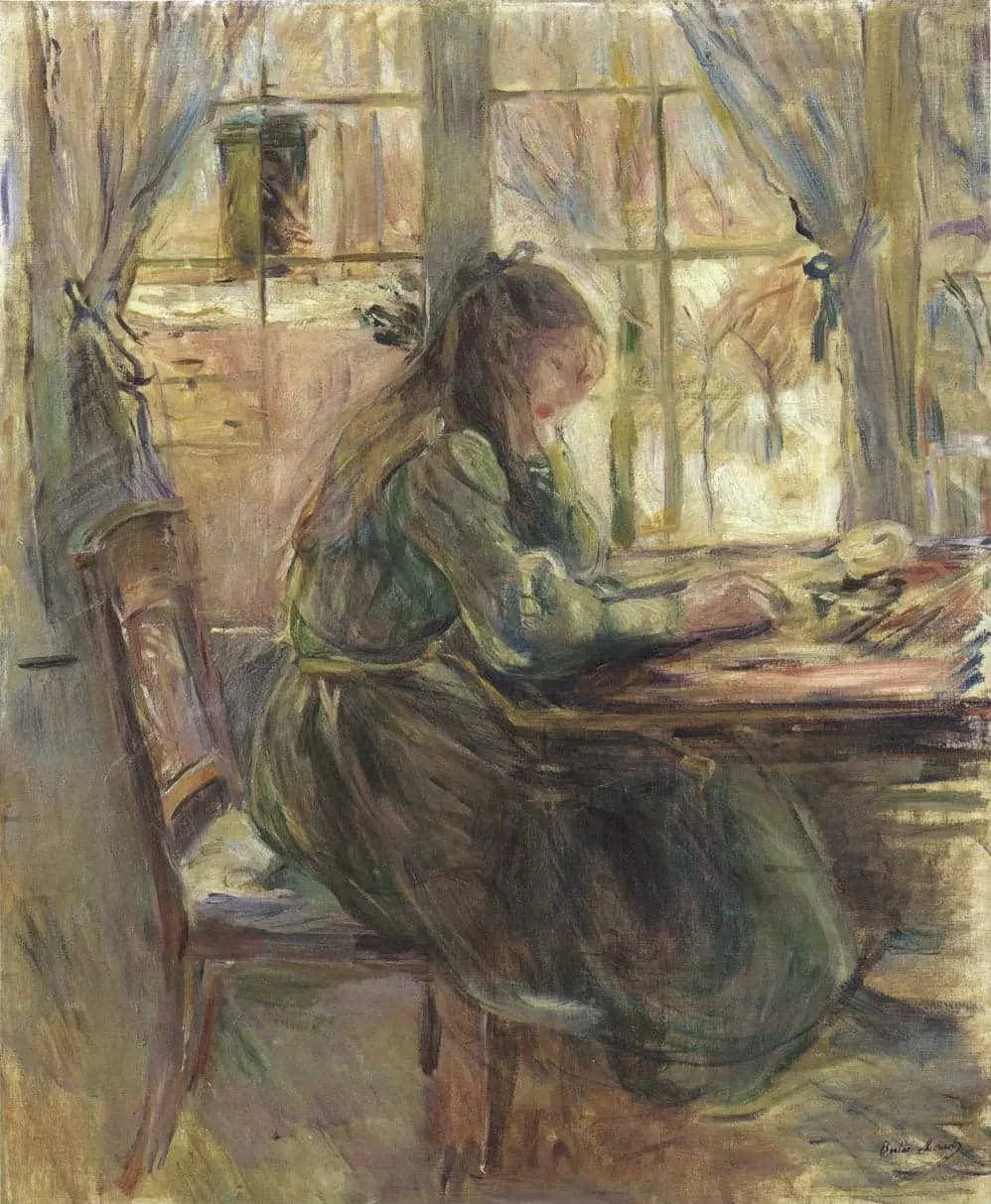
Julie at the Table
- Original dimensions
- 49 x 59 cm
- Museum
- Not specified
- Year
- 1891
Scene depicted
This canvas immerses us in a suspended moment where Julie, a young girl with a delicate appearance, is seated at a wooden table, her hands playing with flowers. Natural light streams through the window, enveloping the space in a gentle warmth. Morisot offers us a window into family intimacy, revealing subtle details: the delicate dishes and the pensive expression of the young girl symbolize both simple joy and latent melancholy.
Historical context
Created in 1891, this painting is perfectly situated in the context of the Belle Époque, in Paris, a period rich in artistic innovations and expressions of daily life. Berthe Morisot , an emblematic figure of the Impressionist movement, captured the essence of femininity and intimacy with this delicate canvas , still admired today for its authenticity. Although the work is not displayed in a well-known museum, its dimensions, 49 x 59 cm, testify to a particularly intimate composition.
Place in the artist's career
“Julie at the Table” represents a key phase in the career of Berthe Morisot , where she evolves towards increasingly personal compositions. In parallel, works like “The Cradle” and “Reading” show her stylistic development by also incorporating themes of motherhood and introspection. This canvas stands out for its ability to capture moments of life while placing emotion at the center of her artistic concerns.
Anecdote
“In every gesture of Julie's hand, the farewell to childhood is discernible.” These words from Berthe Morisot evoke the sweet melancholy that permeates her masterpiece . Inspired one spring evening while observing her niece, she managed to immortalize this fleeting youth. The painting awakens memories of laughter and sweetness, anchoring the moment in an eternity of tenderness.