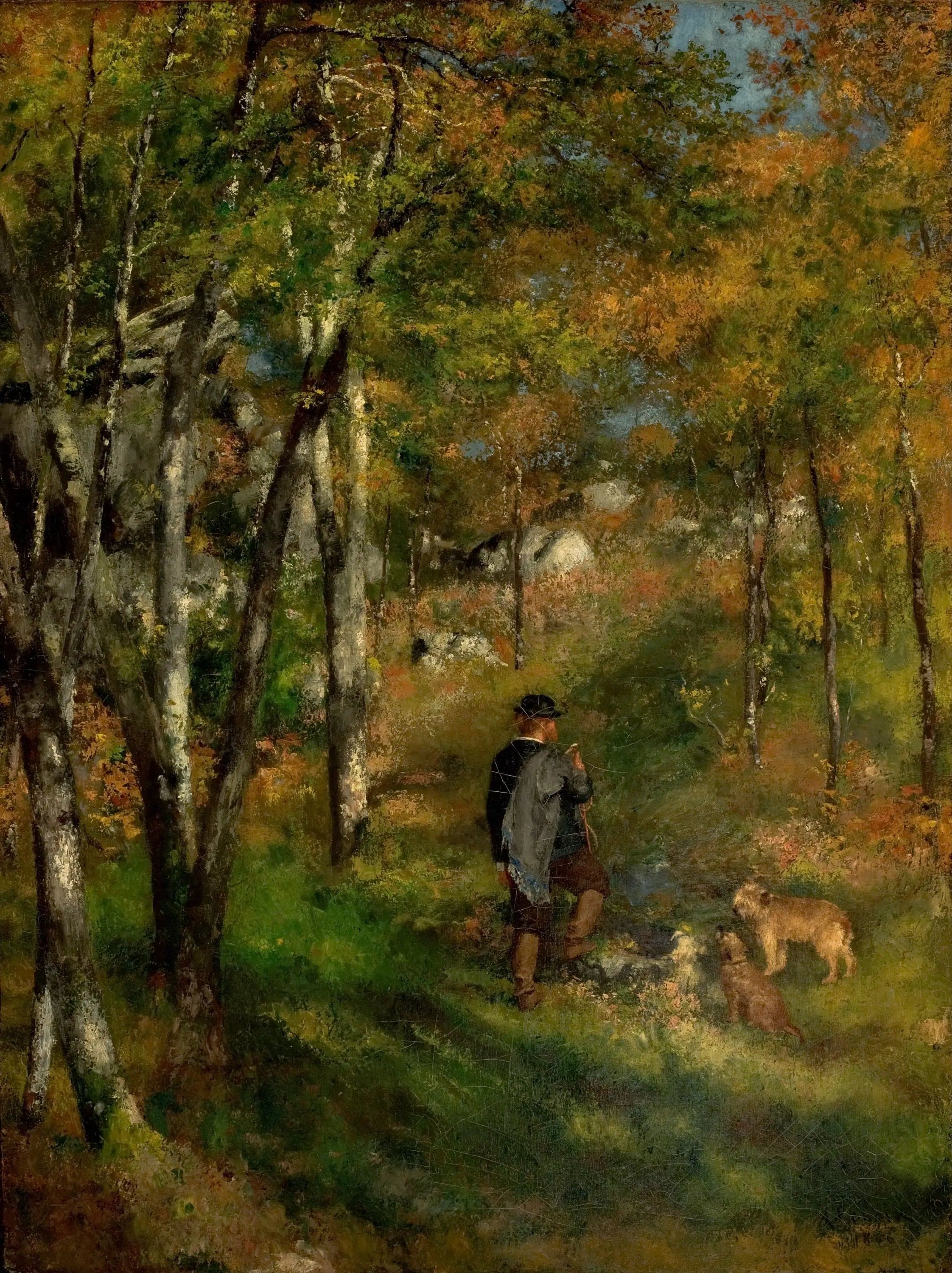
Jules le Cœur and his dogs in the Forest of Fontainebleau - Pierre
- Original dimensions
- 90 x 112 cm
- Museum
- São Paulo Museum of Art
- Year
- 1866
Scene depicted
In this canvas , Renoir depicts the friendship between man and his canine companions, evolving freely in the majestic forest of Fontainebleau. The dogs, joyful and dynamic, bring a lively atmosphere to the scene, while the light weaves through the foliage, animating every detail of this swirling composition. It is a hymn to the love we have for one another, in a setting where nature plays the role of a silent but omnipresent witness.
Historical context
This painting , signed by the master Impressionist Pierre- Auguste Renoir in 1866, is set in the enchanting setting of the forest of Fontainebleau, rich in light and colors. In the midst of the Impressionist period, Renoir captures here a lively scene of everyday life, where nature and animal life coexist harmoniously. Today, the painting proudly resides in the collections of the São Paulo Museum of Art , where it is admired for its visual brilliance and timeless grace.
Place in the artist's career
Jules le Cœur and his dogs in the forest of Fontainebleau marks a significant milestone in Renoir's career, echoing other iconic works such as Le Déjeuner des canotiers and La Danse à la ville . This painting reveals a growing mastery of light play and palpable emotion. Its lively and colorful approach reflects a time when Renoir sought to capture the fleeting beauty of life's moments.
Anecdote
“Nature is a painting, each nuance tells a story,” he might have said. Inspired by the gentle spring mornings in Fontainebleau, Renoir was able to bring to life Jules le Cœur and his dogs in the forest of Fontainebleau thanks to the brightness and natural beauty that surrounded him. This moment of creation is a vibrant echo of the continuity of life that one feels through this work.