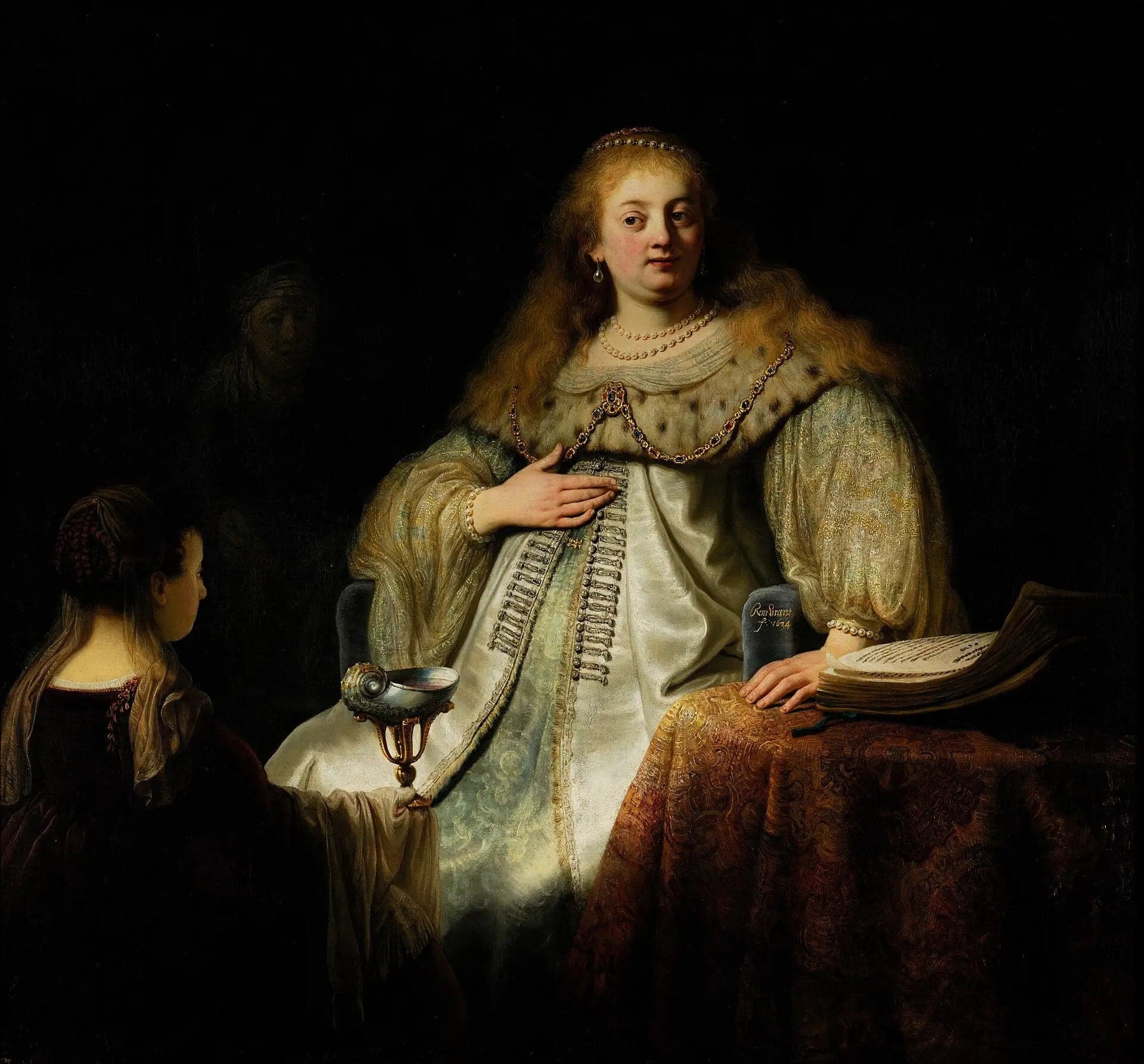
Judith at the Banquet of Holofernes
- Original dimensions
- 154.7 x 143 cm
- Movement
- Dutch Golden Age
- Museum
- Prado Museum
- Year
- 1634
Scene depicted
In this captivating canvas , Rembrandt depicts Judith, a biblical heroine, at the moment of her seduction of the Assyrian general Holofernes. The palpable tension between the characters, the light dancing on their faces, and the richly colored drapery immerse you in the very intrigue of the scene. The atmosphere is saturated with promises and dangers, offering a multi-layered reading.
Historical context
Created in 1634, in the heart of Amsterdam, this painting is emblematic of a time when Dutch art reached unparalleled heights. In the midst of the Baroque period, the canvas stands out for its visual and narrative enigmas. Today, this masterpiece resides in the Prado Museum, a sanctuary of art where visitors can admire its brilliance. Its impressive dimensions of 154.7 x 143 cm make it a must-see in the artistic landscape.
Place in the artist's career
“Judith at the Banquet of Holofernes” is situated at a pivotal point in Rembrandt's career. Between the flamboyance of his early years and the artistic maturity he would later achieve, this painting represents a peak in his psychological exploration of characters, just like his other iconic works such as “The Night Watch” and “The Anatomy Lesson of Dr. Tulp.”
Anecdote
“Art is the mirror of the soul,” said Rembrandt . Imagine him, one spring morning, in his studio bathed in soft light, seeming to capture the whispers of human emotions to transcribe them onto the canvas. This moment of inspiration would undoubtedly have given birth to the evocative power of the painting “Judith at the Banquet of Holofernes,” a work of immeasurable depth.