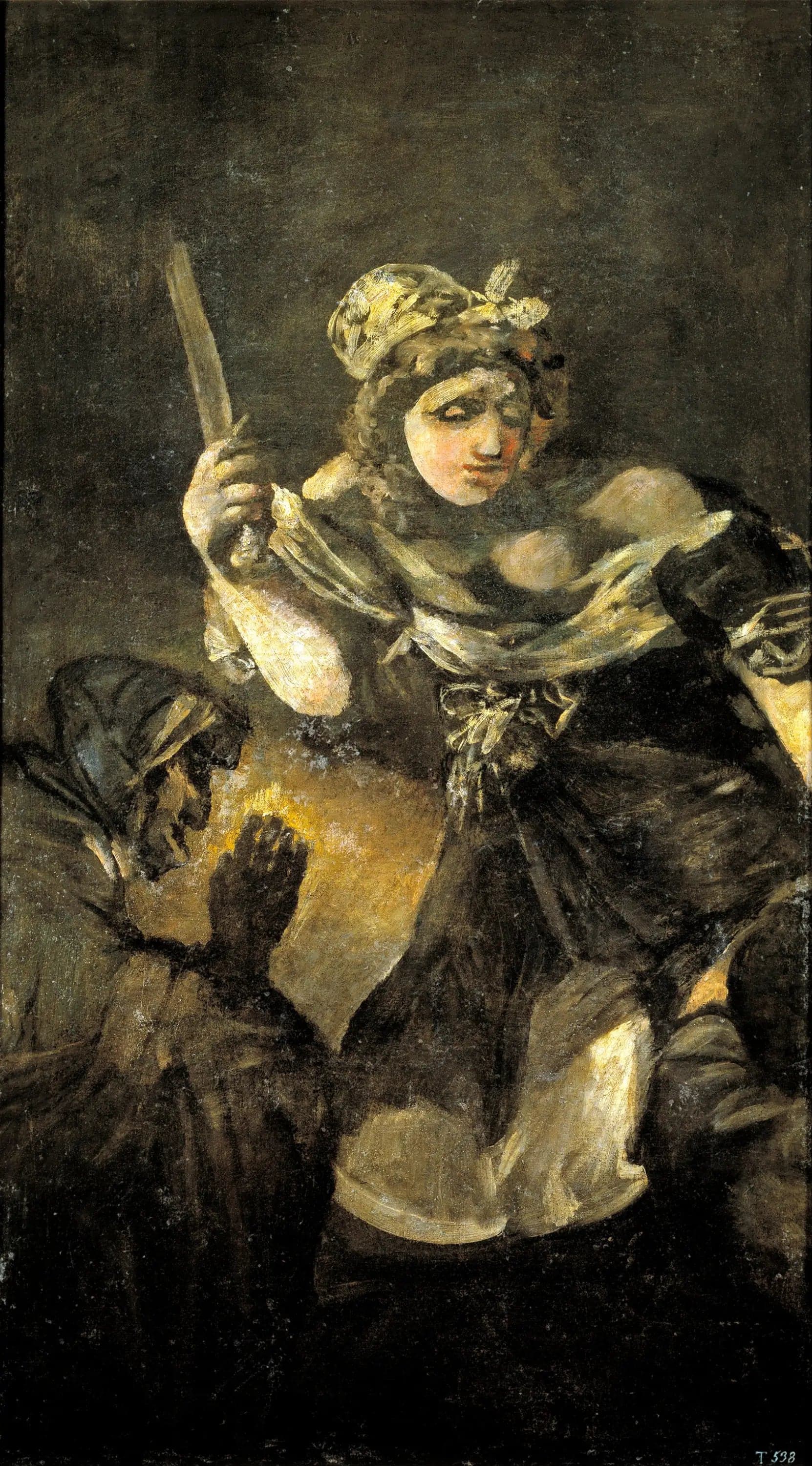
Judith and Holofernes
- Original dimensions
- 84 x 146 cm
- Museum
- Prado Museum
- Year
- 1819
Scene depicted
The painting represents a key moment in the biblical legend, where Judith, brave and determined, stands against the oppressor Holopherne. The scene is imbued with tension and drama, capturing the moment before the fateful action, with striking details conveying Judith's inner struggle. This canvas evokes both strength and fragility, immersing us in an ancient narrative filled with emotion.
Historical context
Created in the heart of Spain, in Madrid, in 1819, the painting Judith and Holopherne represents a striking example of the romantic movement. This period, characterized by emotion and expression, sees Goya stand out as one of the pioneers of this new artistic era. Currently exhibited at the Prado Museum, this canvas , measuring 84 by 146 cm, is a true window into the past, inviting observers to feel the dramatic power of the depicted scene.
Place in the artist's career
Judith and Holopherne is situated in a period of artistic maturity for Goya, where he combines refined technique with controversial themes. Compared to The Disasters of War and The Naked Maja , this canvas illustrates his evolution towards a more personal and emotional expression, marking a turning point in his reflection on the human condition.
Anecdote
“Art is a reflection of the soul, and each brushstroke resonates like a heartbeat.” Francisco de Goya may have sketched this canvas one summer morning, inspired by the wonder and tragedy of human life. In a quiet alley in Madrid, he felt the vibrant force of the feminine heroism that inhabits this masterpiece , transforming pain into beauty.