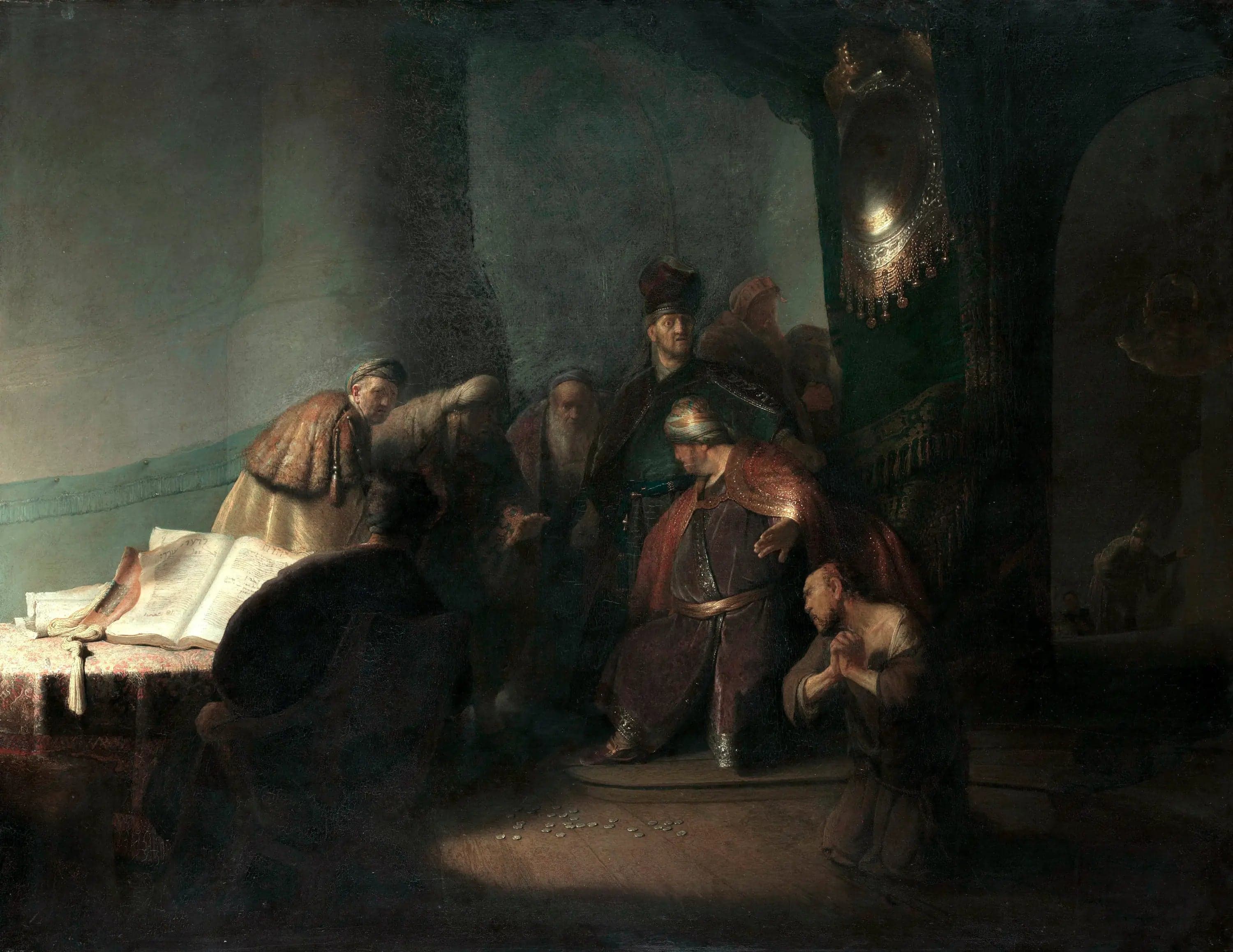
Judas Returns the Thirty Pieces of Silver
- Original dimensions
- 102.3 x 79 cm
- Museum
- Not specified
- Year
- 1629
Scene depicted
This painting depicts the moment when Judas Iscariot, the traitor, receives the thirty pieces of silver in exchange for betraying Christ. The characters are immortalized in palpable tension, their expressions revealing deep feelings of guilt and desire. Through the mastery of shadows and lights, Rembrandt captures not only the act of betrayal but also the emotional impact that ensues, inviting the viewer to contemplate the nature of loyalty and sacrifice.
Historical context
Created in 1629 during the Dutch golden age, this painting emblematic of Rembrandt is a pivotal work of the baroque movement. It reflects a turning point where painting reaches an unprecedented emotional depth. Currently, the canvas is located in private collections, thus preserving its mystical aura and unparalleled legacy.
Place in the artist's career
This canvas marks a decisive step in the career of Rembrandt , as he addresses darker and more dramatic themes. In parallel with “The Anatomy Lesson of Dr. Tulp” and “The Night Watch,” this work reflects the stylistic and emotional evolution of the artist, demonstrating his ability to intuit human suffering through light and color.
Anecdote
“Art is not what you see, but what you make others see.” This quote could very well summarize the approach of Rembrandt as he sketches this pictorial work . Inspired by the morning light filtering through the windows of his studio in Amsterdam, he captured a scene where betrayal mingles with light, generating an echo of contradictory emotions.