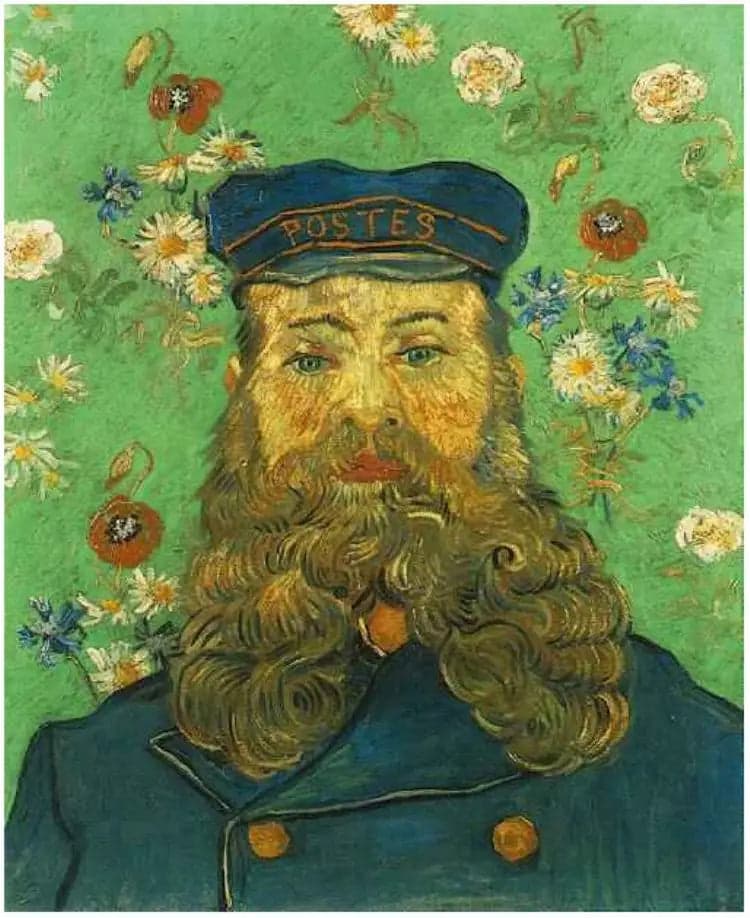
Joseph Roulin
- Original dimensions
- 54 x 65 cm
- Museum
- Kröller-Müller Museum
- Year
- 1889
Scene depicted
This canvas presents Joseph Roulin, a postman in Arles , a faithful friend of the artist. Van Gogh, with his unique expressiveness, uses a vibrant palette to accentuate the character of this protagonist. Roulin's wise gaze, fixed on the viewer, creates an instant, almost palpable connection. This portrait transcends mere art, rising to the level of a true emotional encounter.
Historical context
In 1889, in the heart of Arles , Provence, Vincent van Gogh created this iconic painting , diving passionately into the post-impressionist movement. This moment, filled with emotional intensity, resonates within the tumultuous historical context that art was experiencing at that time. Today, this masterpiece is carefully preserved at the Kröller-Müller Museum , a true sanctuary of art.
Place in the artist's career
“Joseph Roulin” holds a significant place in Van Gogh's career. This painting is part of a period of vibrant creativity, marked by other notable works such as “ The Sunflowers ” and “ The Starry Night .” One can perceive Van Gogh's ambitious stylistic evolution, from his energetic brushstrokes to his more introspective compositions.
Anecdote
“I paint portraits because I love people, and because it gives me the opportunity to live their emotions.” These words from Van Gogh resonate within us when we observe the painting “Joseph Roulin.” Inspired by a spring morning, a sweet exchange in a sunny alley, Van Gogh captures the essence of humanity through the face of his friend, Joseph Roulin. He touches on something fundamental, revealing the intimacy of human relationships.