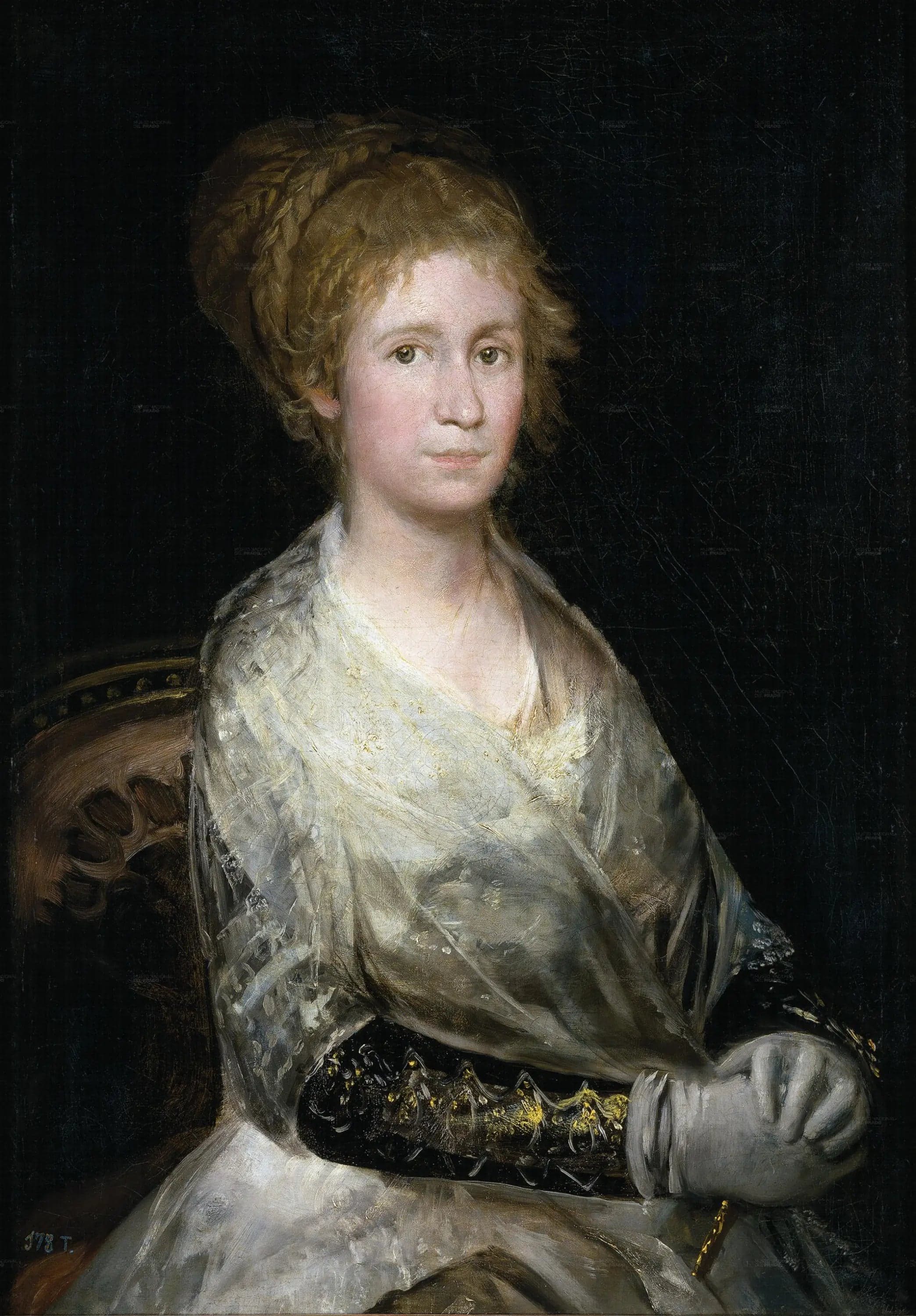
Josefa Bayeu
- Original dimensions
- 58.2 x 82.5 cm
- Museum
- Prado Museum
- Year
- 1814
Scene depicted
This painting embodies the depth of family intimacy. The composition presents Josefa, the painter's sister, radiant and serene, in a pose that exudes great quiet strength. Through her gaze, Goya succeeds in conveying the complexity of human emotions, creating a powerful connection with the viewer.
Historical context
Created in 1814, this painting embodies its roots in Madrid, a city rich in cultural and artistic vibrancy. Francisco de Goya , a prominent figure of Spanish romanticism , captures in this painting the essence of his time, just after the Spanish War of Independence. It is currently housed in the prestigious Prado Museum, a sanctuary for art lovers and a witness to the evolution of painting.
Place in the artist's career
This painting fits into a pivotal period of Goya's career, where he refines his style and technique. At this time, the artist explores more personal and emotional themes; previous experiments, such as “La Maja Desnuda” and “La Maja Vestida,” testify to an evolution towards a more raw and revealing expressiveness.
Anecdote
“Art does not reproduce the visible; it makes visible,” said Goya, and this phrase resonates deeply in the realization of this masterpiece . Inspired one spring morning, he paused before the portrait of Josefa Bayeu, where light played on her face, capturing an ephemeral emotion that became eternal in this canvas .