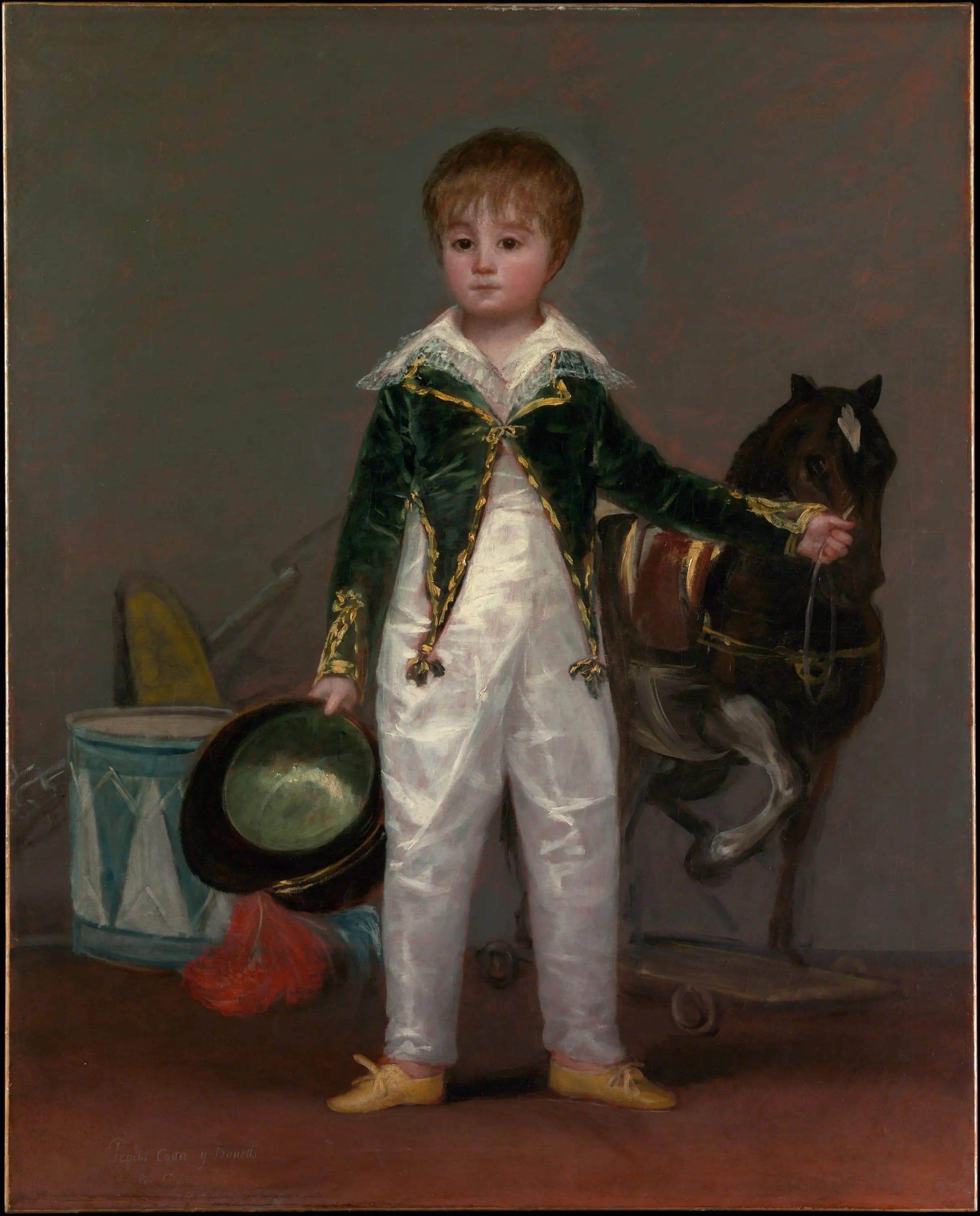
José Costa y Bonells, known as Pepito
- Original dimensions
- 84.5 x 105.1 cm
- Museum
- Metropolitan Museum of Art
- Year
- 1800
Scene depicted
The painting depicts a young boy with a mischievous look, wrapped in dark drapery that contrasts with his radiant youth. His relaxed posture and charming smile reveal a moment of pure intimacy, capturing the very essence of childhood. Each brushstroke highlights the finesse of the details, from the delicate reflections of light on his face to the rich textures of his clothing.
Historical context
This iconic painting , created in 1800, immerses us in the romantic Spain of the late 18th century, a time marked by the awakening of artistic sensibilities. Goya, master of romanticism , captures here the tenderness of a young boy, frozen in an expression of innocence. The work is currently displayed at the famous painting of the Metropolitan Museum of Art , in New York, where it continues to move generations of art lovers.
Place in the artist's career
This painting occupies a central place in the career of Francisco de Goya , marking the beginning of his artistic maturity. At this time, the artist works between hope and disillusionment, as evidenced by key works such as “Las Meninas” and “The Family of Charles IV.” Goya asserts his style here, balancing a heightened sensitivity and a raw realism , influencing future generations.
Anecdote
“The innocence of childhood is a treasure we must preserve,” said Goya, as he observed children playing in the streets of Madrid, the sweet scent of spring flowers floating in the air. This moment of inspiration gave birth to this masterpiece , “José Costa y Bonells, called Pepito,” a reflection on the preservation of innocence in a world on the brink of change.