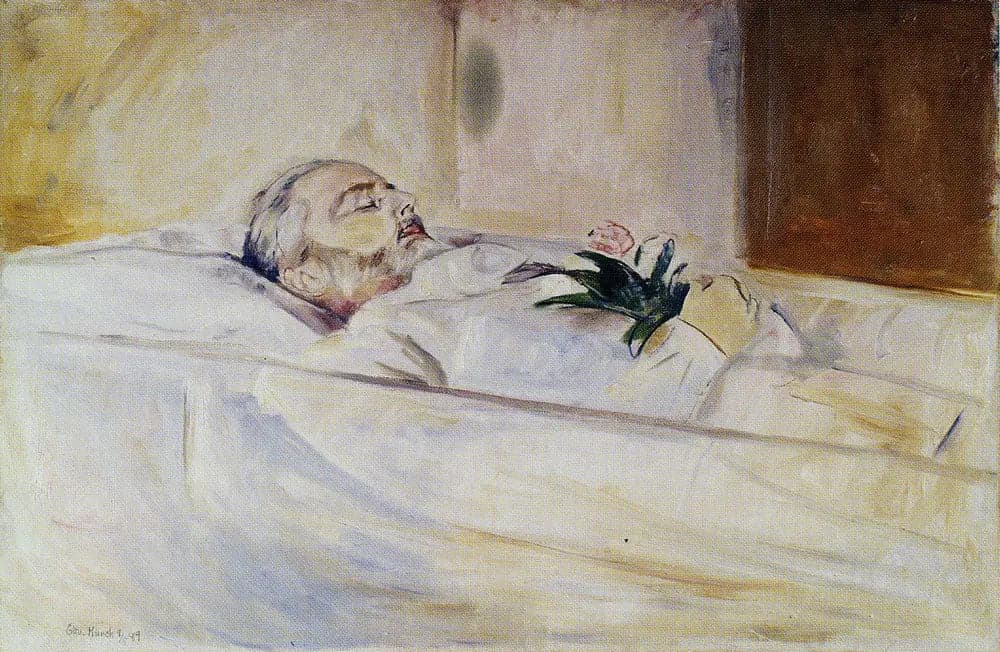
John Hazeland on his Deathbed
- Original dimensions
- 81 x 54 cm
- Museum
- Not specified
- Year
- 1889
Scene depicted
This pictorial work represents the solemn moment of John Hazeland's death, a dear friend of Edvard Munch . The scene, etched in the artist's memory, depicts an atmosphere of despair and introspection. Every element of the canvas testifies to the fragility of life, where the silence of a funeral chamber is palpable, the shadows and lights playing a critical role in narrating this tragic story.
Historical context
Created in 1889, this painting embodies its roots in the expressionist movement born in Oslo, Norway. As Europe undergoes a sociocultural turning point, Edvard Munch captures with his canvas the ambient melancholy of a changing era. Today, the painting remains a coveted work, traversing galleries around the world without a precise location to denote.
Place in the artist's career
John Hazeland on his Deathbed is situated at a turning point in Edvard Munch 's career, then in full exploration of themes related to mortality. Compared to The Scream and The Madonna , two other major paintings , this masterpiece reflects a marked evolution towards dark introspection, rooted in the expression of the deepest human emotions.
Anecdote
“Every painting I create results from an unexpected intersection between spirit and emotion, capturing the ephemeral nature of life,” confessed Munch. This quote resonates particularly during the creation of John Hazeland on his Deathbed , a work completed in a moment of introspection, where the artist absorbed the human suffering he felt around him, transforming this challenge into a poignant composition .