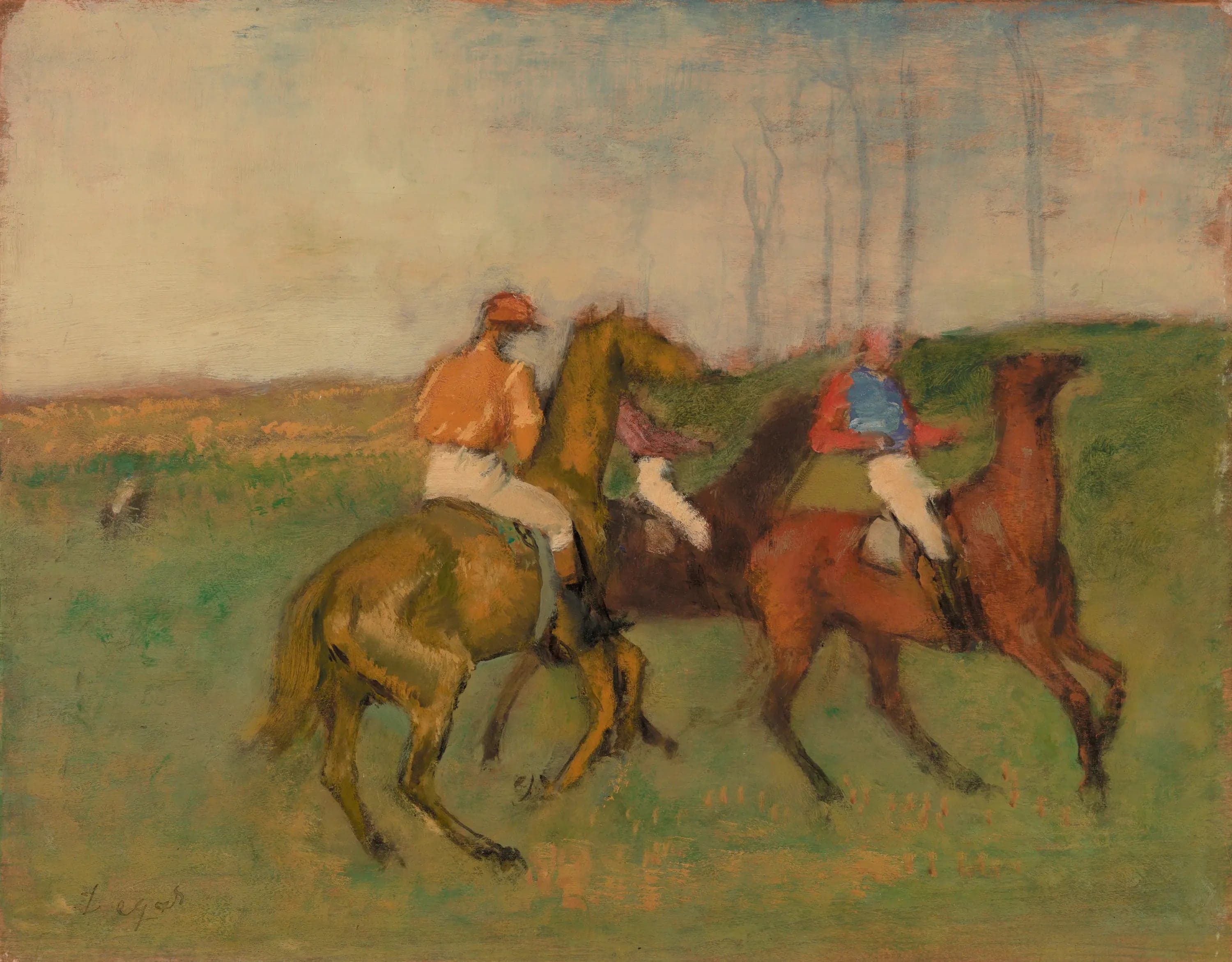
Jockeys and Racehorses
- Original dimensions
- 41 x 32 cm
- Museum
- Barnes Foundation
- Year
- 1890
Scene depicted
The painting “Jockeys and Racehorses” depicts the frenzy of a race, a frozen moment where the jockeys, dressed in bright colors, seem to engage in a fierce struggle, while the horses, captured in all their power, appear ready to spring forward. It is a ballet of movements, colors, and emotions, where every detail contributes to conveying the palpable tension of the competition.
Historical context
Created in 1890, this magnificent painting is set against the backdrop of Paris during the Belle Époque. The canvas, emblematic of the Impressionist movement, brilliantly captures the energy of horse racing, a favored event of the time. Displayed at the Barnes Foundation , this painting measuring 41 x 32 cm reflects the innovation and emotion of its creator in a society undergoing transformation.
Place in the artist's career
This painting marks a milestone in Degas's career, embodying a period of artistic maturity. Both technical and emotional, it stands alongside other works such as “The Dance Class” and “The Dancers.” These paintings testify to the evolution of his style, moving from the observation of everyday life scenes to dynamic compositions, where light and movement take center stage.
Anecdote
Edgar Degas once stated: “I feel alive when I paint movement.” The vibrant gestures of the jockeys and the fervor of the horses captured in a moment of inspiration at the edge of a training track add an extra dimension to this masterpiece . This quote resonates as an echo of his dedication to capturing the very essence of the moment.