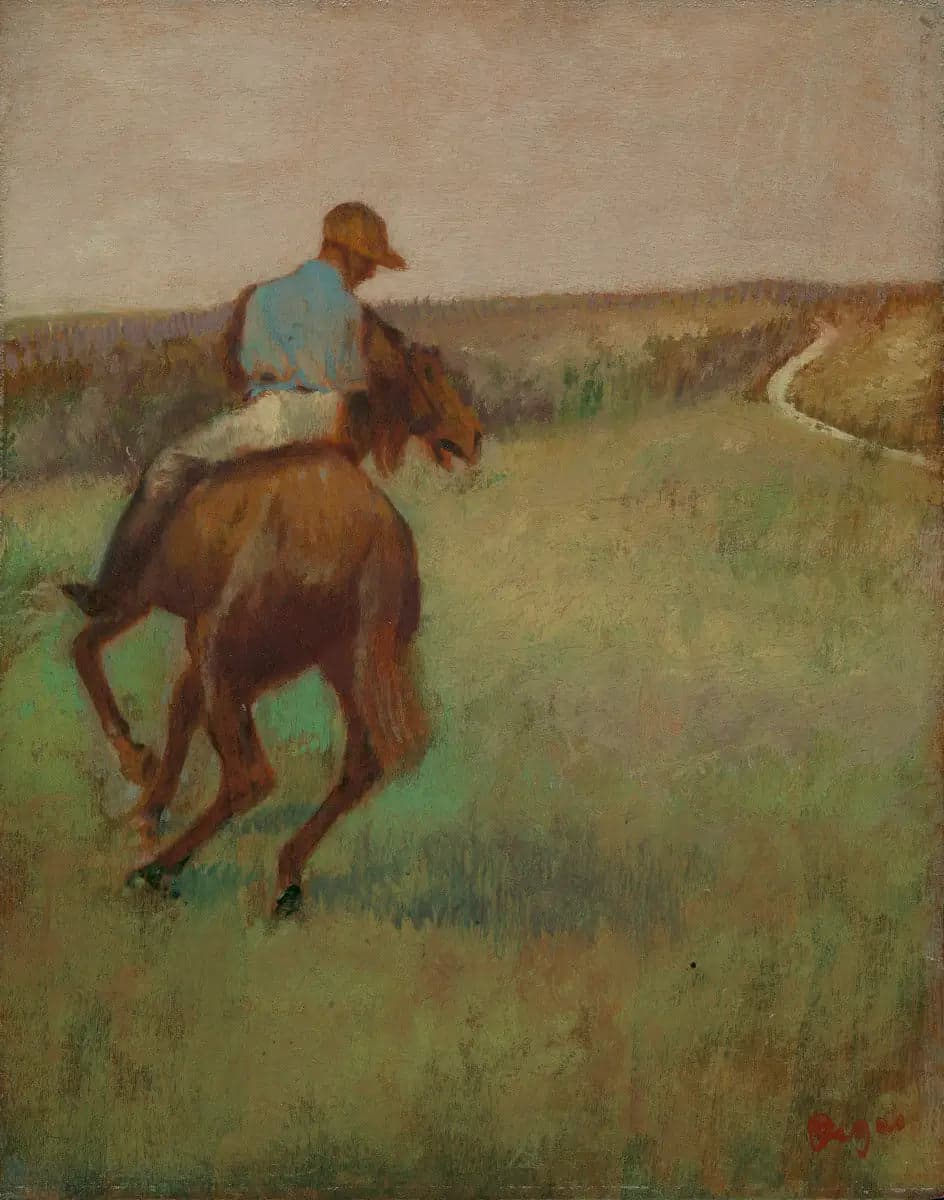
Jockey in blue on a chestnut horse
- Original dimensions
- 20.6 x 26 cm
- Museum
- Virginia Museum of Fine Arts
- Year
- 1889
Scene depicted
The painting brilliantly depicts a jockey in blue on a chestnut horse, frozen in a dynamic and graceful movement. The composition, characteristic of Degas's style, evokes the palpable tension of the races while highlighting the beauty of the mounts and the elegance of the riders. The spectators, although present, seem to blend into the background, allowing the painter to focus attention on the relationship between the jockey and his horse.
Historical context
Created in 1889, this painting takes place in a Paris dazzled by innovation and artistic movements of the late 19th century, where the Impressionist movement asserts itself. This painting, now exhibited at the Virginia Museum of Fine Arts , is a perfect reflection of its time, navigating between tradition and modernity, captivating minds with the fluidity of its avant-garde.
Place in the artist's career
Jockey in Blue on a Chestnut Horse represents a key phase in Degas's career, with his style evolving towards a bolder and more dynamic representation. As both a precursor of the Impressionist movement with his bright painting , it shares similarities with works like The Dancers and The Horse Race , which also illustrate his interest in movement and everyday life.
Anecdote
“The light rests on the horses like a caress,” said Degas as he observed horse races at Auteuil. This quote perfectly illustrates the genesis of the masterpiece that is Jockey in Blue on a Chestnut Horse . One spring morning, enveloped by the scent of fresh grass and the murmur of crowds, he captured this vivid scene that still resonates today with its intensity.