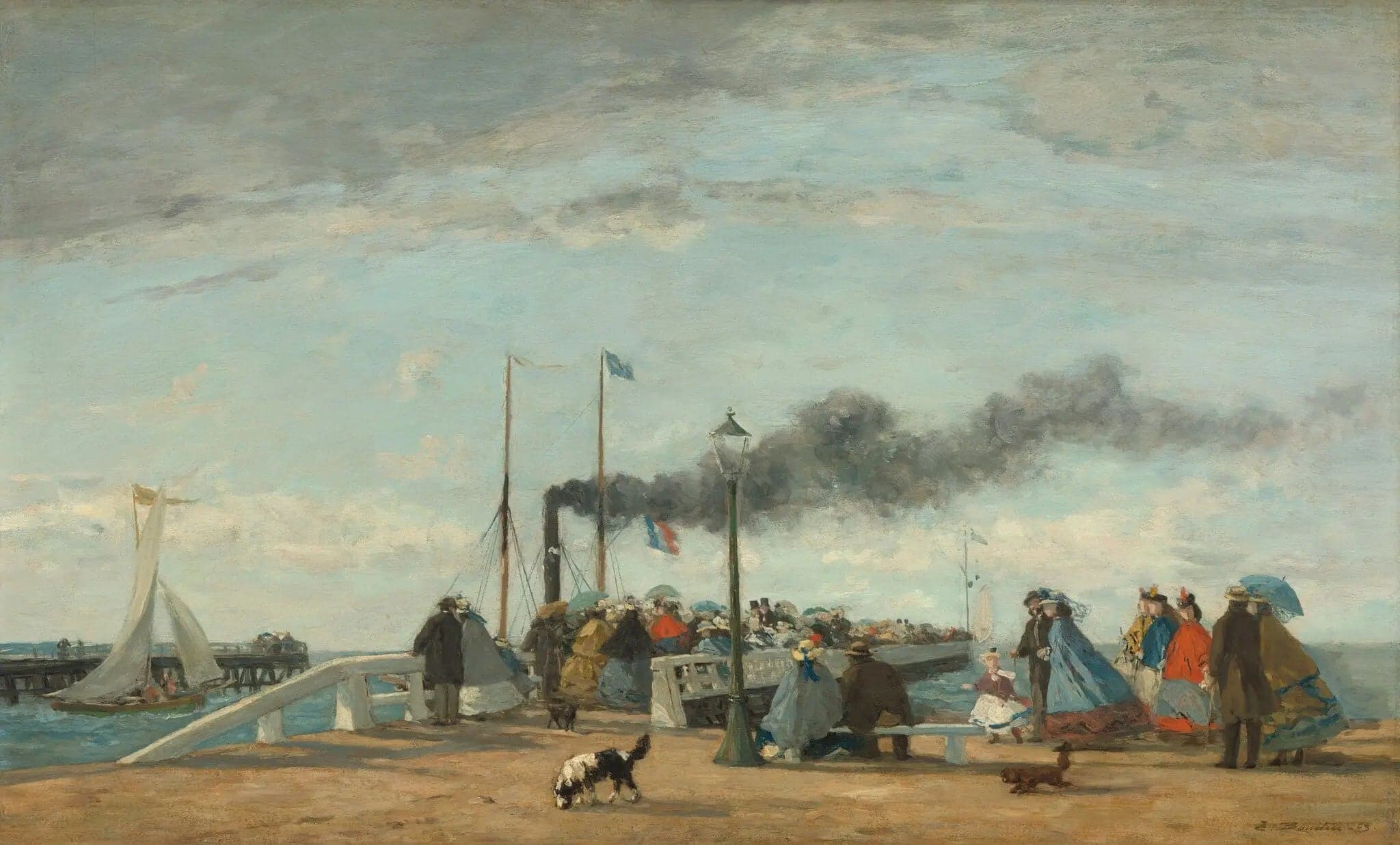
Jetty and Quay of Trouville
- Original dimensions
- 58 x 34.8 cm
- Museum
- National Gallery of Art
- Year
- 1863
Scene depicted
“Jetée et quai de Trouville” presents a lively scene of 19th-century seaside society. The silhouettes of walkers mingle with the sails of fishing boats, while the light dances on the waves. This painting bears witness to a time when the sea and its shores offered moments of socialization and escape, resonating with the hearts of summer visitors. The painting depicts a world where every detail matters, and where the horizon ignites under the setting sun.
Historical context
This painting emblematic was created in 1863, in Trouville-sur-Mer, a French commune in the Normandy region. Eugène Boudin , precursor of the impressionist movement, is part of an innovative artistic current, depicting light, the sea, and scenes of daily life. Today, this canvas is preserved at the National Gallery of Art , where visitors can admire its captivating dimensions of 58 by 34.8 centimeters.
Place in the artist's career
“Jetée et quai de Trouville” marks a significant milestone in the career of Eugène Boudin , highlighting his transition from realism to a more free impressionist style. Compared to works like “La Plage de Trouville” and “La Femme au parasol”, this canvas illustrates his artistic evolution, blending gray techniques and light research. Boudin's maturity is drawn in this composition, where the sea accompanies the human soul.
Anecdote
“The ephemeral beauty of the moment is my greatest source of inspiration.” These words from Eugène Boudin evoke a spring morning on the Normandy coast. It is in this idyllic setting, between the surf of the sea and the breath of the wind, that he conceived this masterpiece . The canvas “Jetée et quai de Trouville” is imbued with this passion for nature, where each brushstroke reflects the brilliance of a moment frozen in time.