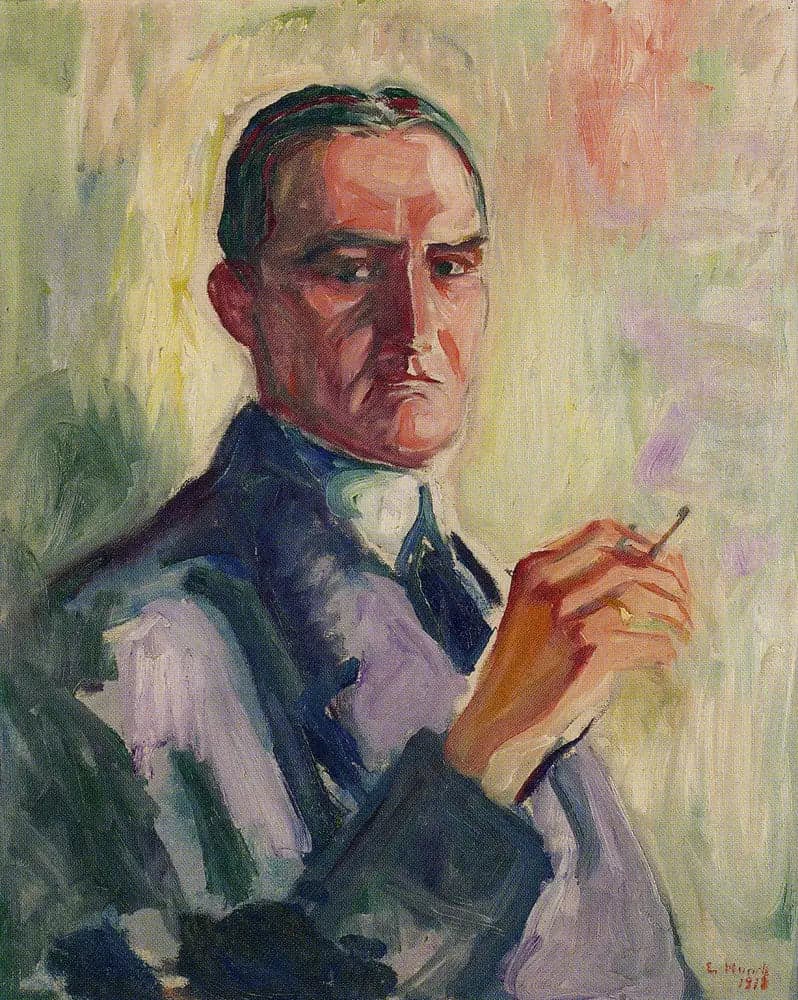
Jérôme Heyerdahl
- Original dimensions
- 72 x 100 cm
- Museum
- Not specified
- Year
- 1917
Scene depicted
In this canvas , Edvard Munch captures the essence of a fleeting moment, exploring the face of Jérôme Heyerdahl. The deep gaze, blending softness and melancholy, expresses an introspection that transcends time. The vibrant colors and bold strokes reveal an atmosphere of deep reflection, combining both calm and turbulence.
Historical context
Created in 1917, in the tumultuous context of Europe, the painting "Jérôme Heyerdahl" is situated in the artistic effervescence of the time. Munch, at the forefront of the expressionist movement, infuses his work with reflections on the human condition. Although the current location of this canvas is not specified, its impact remains unchanging, captivating the minds of art lovers. Its dimensions, 72 x 100 cm, make it a piece that is both filled with presence and intimacy.
Place in the artist's career
The painting "Jérôme Heyerdahl" represents a significant milestone in Munch's career, marking the maturity of his style. Comparable to "The Scream" and "Madonna", these works testify to an evolution towards a deeper exploration of the human soul, through rich and poignant compositions.
Anecdote
“True beauty lies in the shadow of the soul.” Perhaps it was on a sunny morning, in the heart of a Nordic landscape, that Munch found inspiration for this masterpiece , observing the nuances of light playing on the thoughtful face of Jérôme Heyerdahl.
Major exhibitions
Edvard Munch : portretter