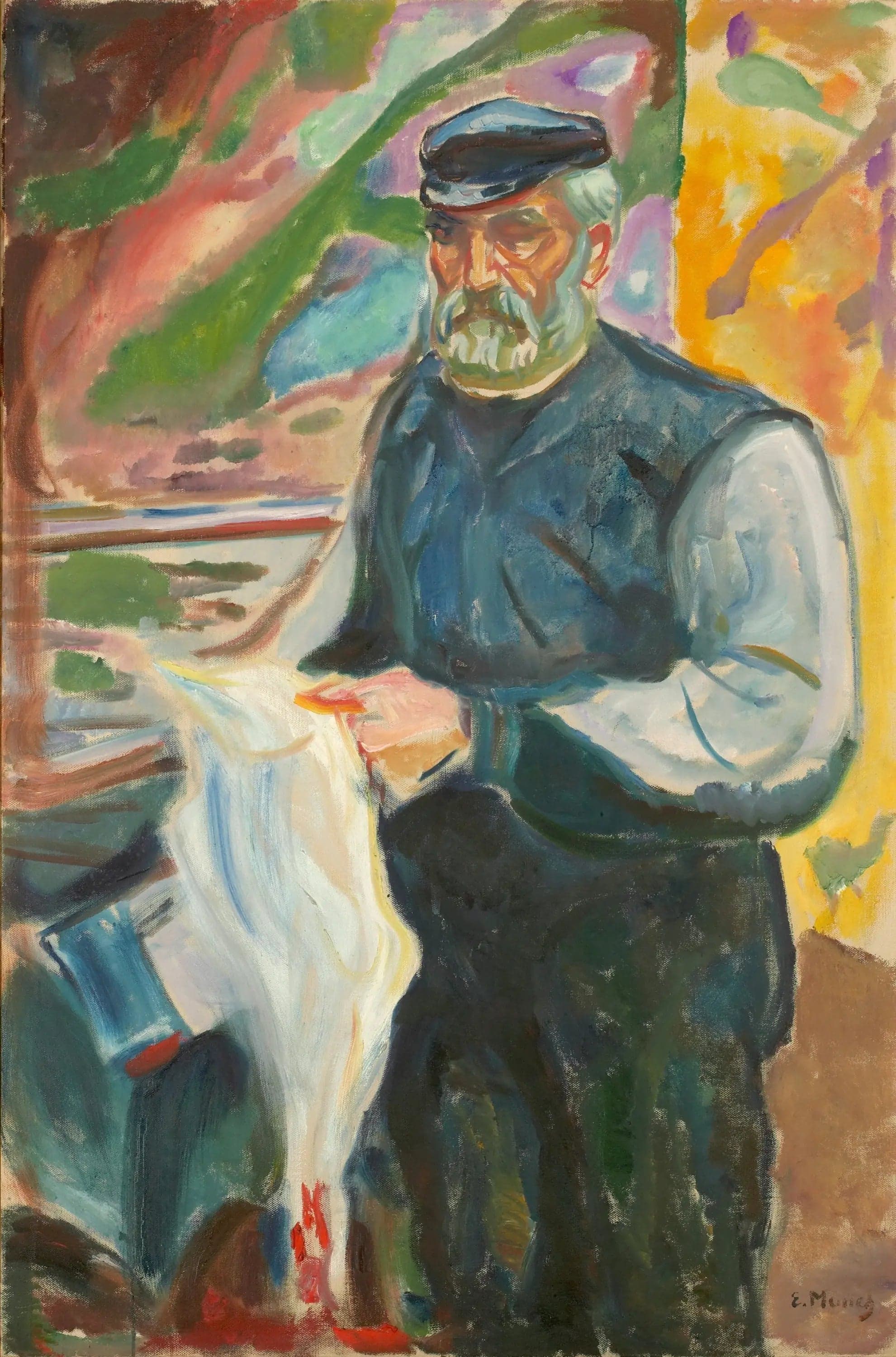
Jensen with a Dead Duck
- Original dimensions
- 99 x 150 cm
- Museum
- Munch Museum
- Year
- 1912
Scene depicted
The painting “Jensen with a dead duck” depicts a striking scene that confronts the viewer with the duality of life and death, a recurring theme in Munch's work. The duck, a symbol of nature, is presented in a setting that invites reflection on the fragility of existence. The composition reveals an introspective gaze, - both gentle and tragic - on the cycle of life.
Historical context
Created in 1912, this painting emblematic of Edvard Munch finds its roots in the vibrant city of Oslo, formerly known as Christiania, marking an era rich in artistic evolutions. Strongly influenced by the expressionist movement, Jensen with a dead duck embodies the revolutionary spirit of a time when art underwent a profound transformation. The painting is currently housed in the Munch Museum, where it continues to evoke emotions in visitors, measuring 99 x 150 cm and revealing the mastery of the artist.
Place in the artist's career
This painting fits into a key period of Munch's career, where he transitions from a promising young artist to a recognized master, exploring profound themes. Placing it alongside The Madonna and The Scream , one observes a significant stylistic evolution that highlights his ability to capture raw and human emotions in his paintings .
Anecdote
“Nature itself is a perpetual work of art, and capturing a fragment of it is to seize an eternal emotion.” In this quote, Munch evokes the inspiration behind the canvas . He found himself before a melancholic landscape, one foggy morning, where the scents of the damp earth mingled with the sharp cries of birds. This fleeting moment infused new life into this work .
Major exhibitions
Edvard Munch . Monumental projects