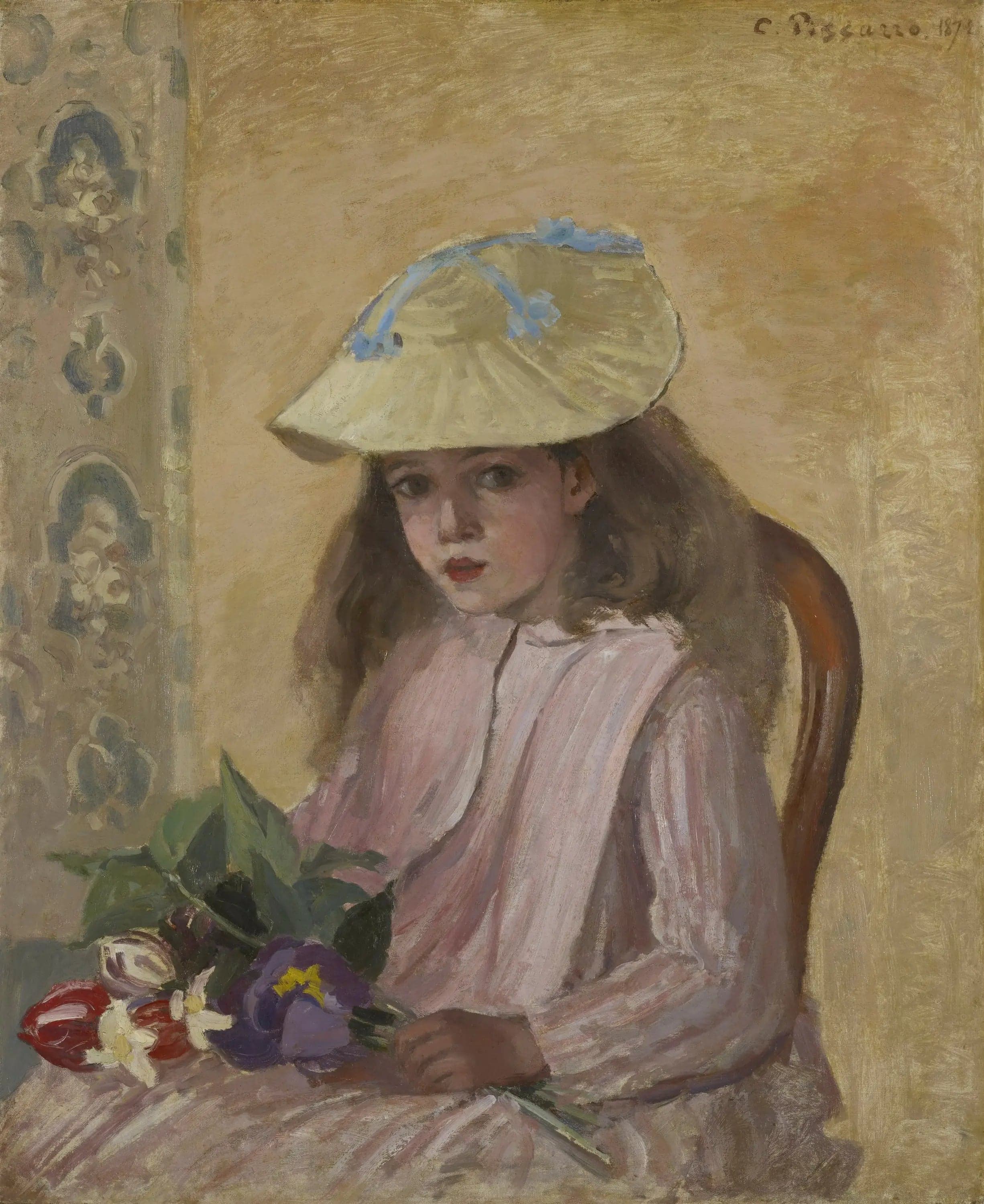
Jeanne Pisarro called Minette with bouquet
- Original dimensions
- 59.5 x 72.7 cm
- Museum
- Yale University Art Gallery
- Year
- 1872
Scene depicted
The painting brings together the innocence of childhood and the delicacy of nature. Jeanne, light and radiant, is depicted in full bloom of a bouquet, a symbol of love and beauty. The background, blurred and soft, evokes a gentle morning, tones of greenery caressed by light playing on shapes and shadows, creating a peaceful, almost dreamy atmosphere.
Historical context
This painting emblematic was created in 1872, in Paris, a city vibrant with artistic effervescence at the heart of the impressionist movement. The lights of this era, bathing urban and rural scenes, have imbued the soul of Camille Pissarro , who also stood at the crossroads between tradition and modernity. Today, this canvas is part of the precious collections of the Yale University Art Gallery , a sanctuary of artistic masterpieces, extending over 59.5 x 72.7 cm.
Place in the artist's career
This painting occupies a delicate place in Pissarro's work, marking a period of maturation where human emotion intertwines with the ephemeral beauty of moments. At the time, Pissarro alternated between portraits of children and landscapes, as evidenced by his works "The Garden of Eragny" and "The Harvest of Apples," revealing an evolution where each canvas testifies to a depth laden with emotion.
Anecdote
Pissarro often stated: "Nature is defined not only by its colors but by its emotions." It was on a spring morning that the artist crossed paths with Jeanne Pisarro, his daughter, holding a blooming bouquet. This fleeting moment, filled with light and tenderness, captured not only his muse but also the essence of a canvas marked by familial love and the beauty of small things.