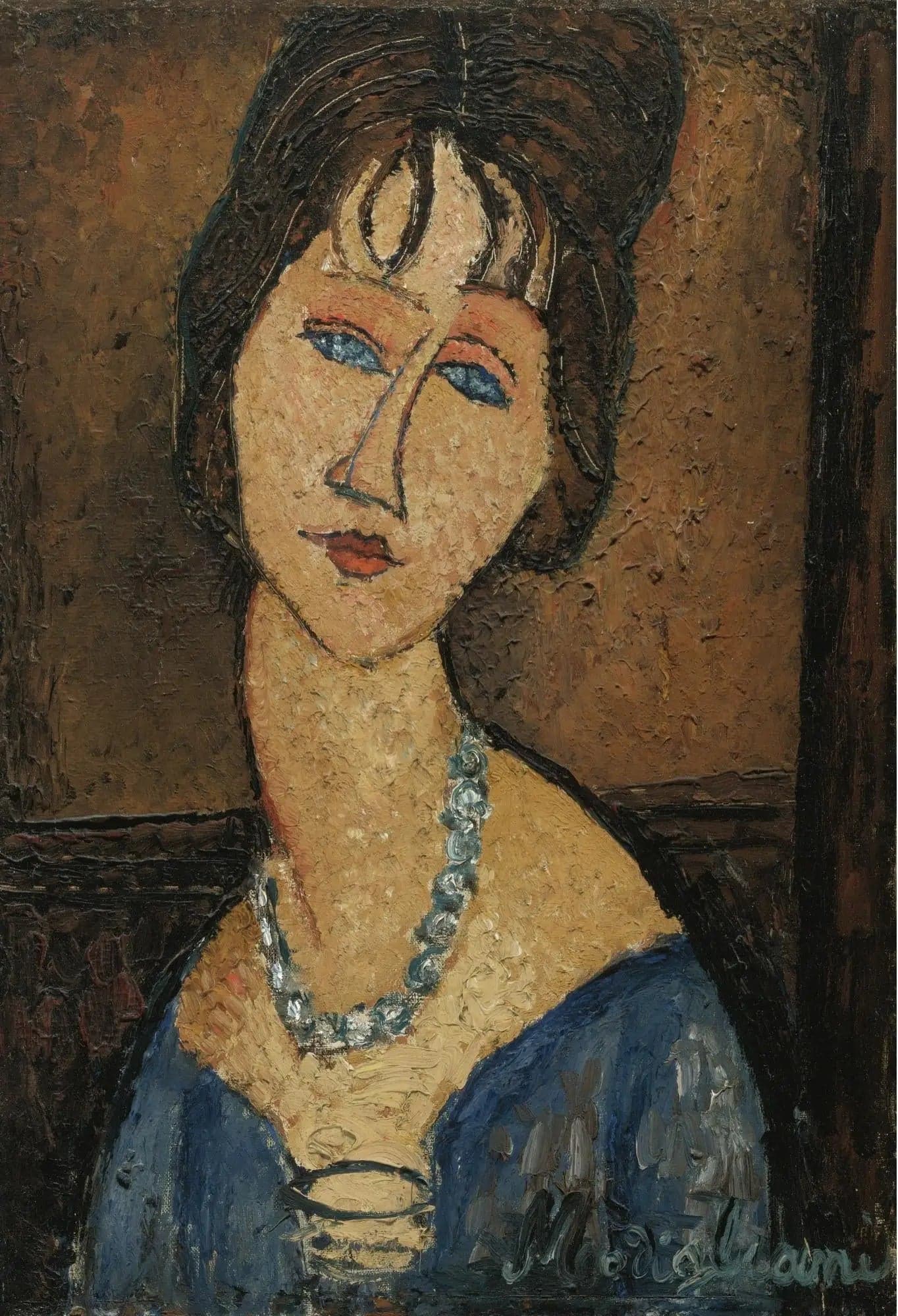
Jeanne Hébuterne with Necklace
- Original dimensions
- 38.7 x 55.8 cm
- Museum
- Not specified
- Year
- 1916
Scene depicted
In this canvas , Modigliani offers us a poignant vision of Jeanne Hébuterne, his companion and muse. The spiritual painting reveals her face, framed by soft lines and shimmering hues, while the necklace she wears illuminates her enchanting beauty. This portrait is much more than a simple representation; it embodies the synergy between the artist and his subject, celebrating the delicate grace of this woman through the prism of love and creativity.
Historical context
Created in 1916, in the Paris of the time, this painting is part of the Fauvist movement, the artistic movement that disrupted the conventions of color and style. It is in the City of Light, where art experienced an unprecedented creative effervescence, that Modigliani created this canvas celebrating his muse, Jeanne Hébuterne. Sad irony, this masterpiece transcends the misfortunes of its time and honors the passionate love that united the two artists, even though this canvas is not currently exhibited in a well-known museum.
Place in the artist's career
Jeanne Hébuterne au Collier represents a turning point in Modigliani's career, a period when his style reaches remarkable artistic maturity. Among his other canvases , such as La Femme à la collerette and Nu couché, one can perceive the evolution of his approach to portraiture. This pictorial work testifies not only to his technical virtuosity but also to the emotional intensity that characterizes his production at that time.
Anecdote
“Art is our refuge, a reflection of our deepest emotions.” These words attributed to Modigliani resonate particularly in this pictorial work . Imagine a spring morning, where the golden light filters through the windows of his studio, and a glance exchanged at the turn of an alley becomes forever immortalized on the canvas. This intimate moment is palpable in the evocative power of Jeanne Hébuterne au Collier, making this painting eternal.