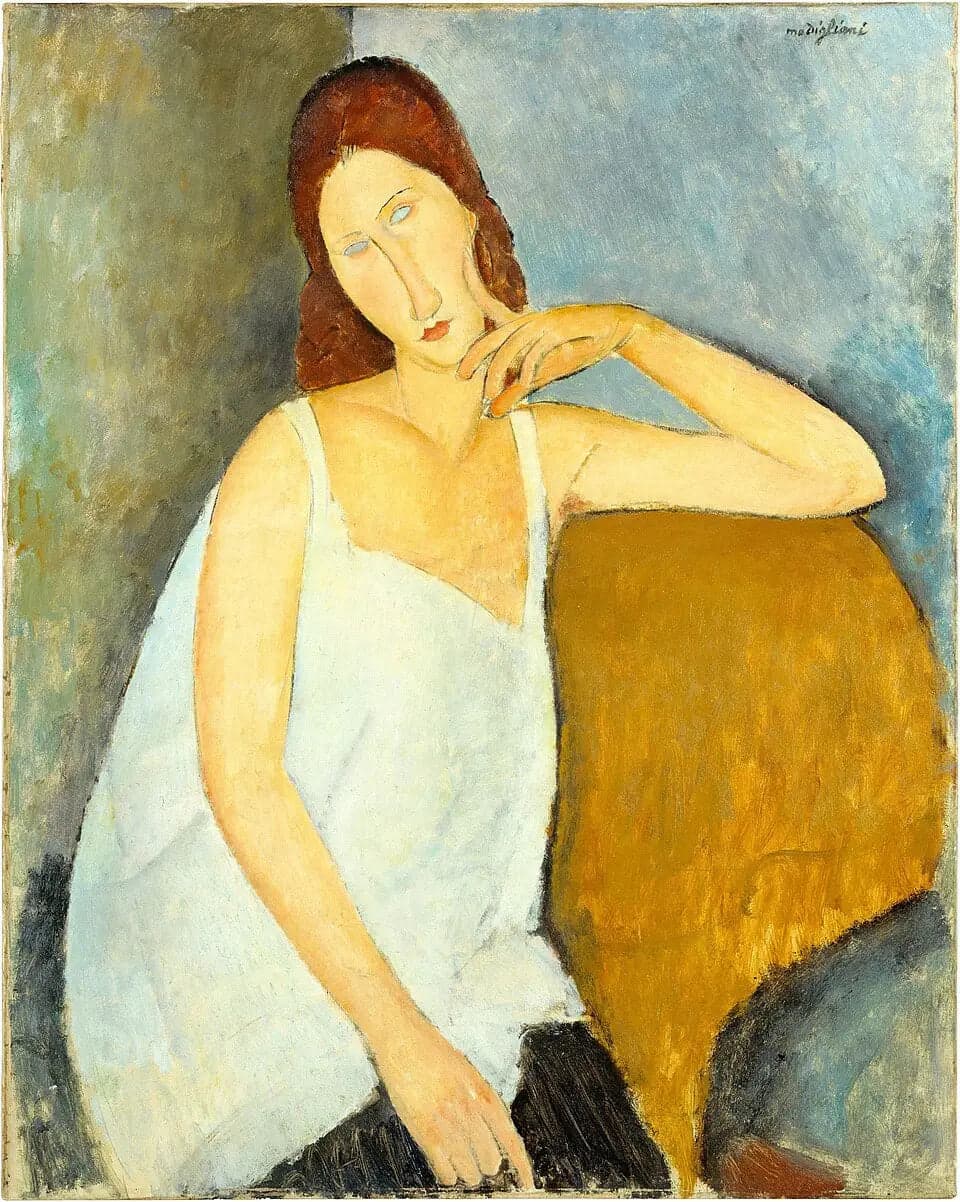
Jeanne Hébuterne with Bare Shoulders
- Original dimensions
- 73 x 91.4 cm
- Museum
- Not specified
- Year
- 1919
Scene depicted
This painting depicts Jeanne Hébuterne, the muse and companion of the painter, in a delicate pose, highlighting the grace of her face and the softness of her bare shoulders. This timeless classic illustrates the very essence of the beloved woman, both vulnerable and powerful. The fluid lines and stylized forms enhance the impression of a dreamy gaze, immersed in a suspended moment.
Historical context
Created in 1919, this painting emblematic of Modigliani finds its roots in the vibrant Paris after World War I. The painting is the result of the artistic movement of modernism , characterized by its boldness and quest for unique expression. At that time, Modigliani, settled in the French capital, distinguished himself by his ability to capture human sensitivity through his portraits of unparalleled depth. Currently, this painting , a testament to his creative genius, is not exhibited in a known museum, but its imprint in the history of art remains indelible.
Place in the artist's career
This painting , Jeanne Hébuterne aux épaules nues, represents a turning point in Modigliani's career, marking a culmination of his technical mastery. It is part of a series of emblematic portraits, alongside works such as "Nu couché" and "Portrait de femme". Each of these canvases bears witness to the evolution of his style, his explorations of forms and colors over time.
Anecdote
One day, Modigliani reportedly declared while observing his muse, Jeanne: “Beauty does not reside in detail, but in the strength of the soul.” This quote, inspired by those moments of wonder spent in his studio, sheds light on the genesis of the masterpiece . In the serenity of the Parisian twilight, Modigliani captured a unique softness, elevating the canvas beyond a mere portrait, inscribing it in the intimate and the eternal.