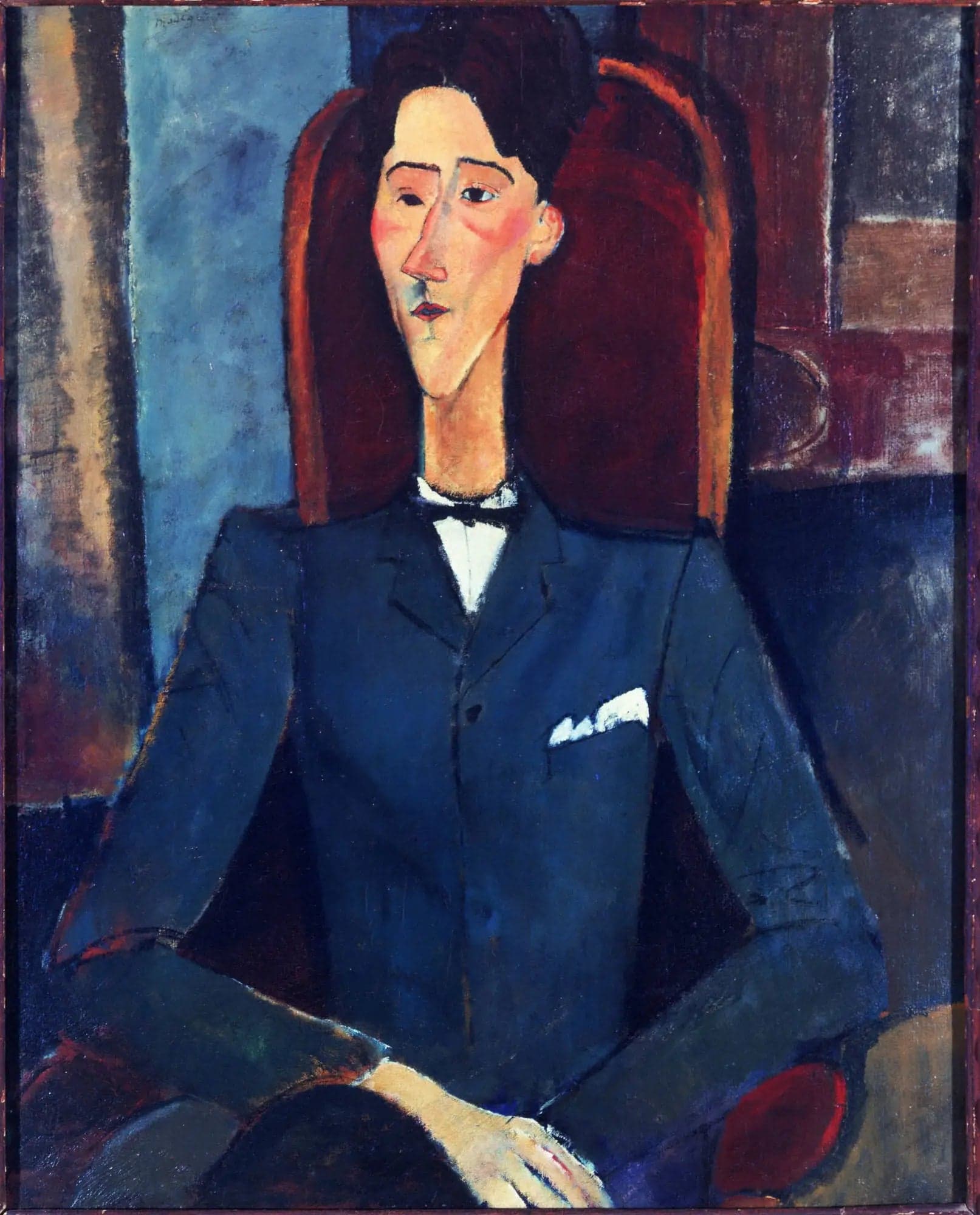
Jean Cocteau
- Original dimensions
- 81.3 x 100.4 cm
- Museum
- Princeton University Art Museum
- Year
- 1916
Scene depicted
In this painting , Modigliani offers a striking glimpse into the intimacy of an iconic creative figure. Jean Cocteau, with his gaze lost in contemplation, attends to the meeting of art and poetry. The fluid shapes and delicate contours tell a story of passion and psychological depth, the composition oscillating between the real world and the world of ideas.
Historical context
Created in 1916 in the vibrant and tumultuous setting of Paris, this painting embodies the pulses of the modernist artistic movement. Jean Cocteau, immortalized by the talented hand of Amedeo Modigliani , stands at the heart of an era where artistic expression transcends established conventions. The painting, now displayed at the prestigious Princeton University Art Museum , gracefully spans over 81 centimeters in width, capturing the majesty of each brushstroke.
Place in the artist's career
Jean Cocteau is situated at the peak of Modigliani's artistic maturity. At this moment in his career, the artist unveils his philosophy through a work that complements previous paintings , such as “Seated Nude” and “Woman with a Parasol.” These pieces echo a stylistic evolution where the simplification of forms and the richness of emotions converge.
Anecdote
“Every face is a poem.” This phrase from Amedeo Modigliani resonates in every detail of his masterpiece . In a quiet alley of Montparnasse, in the early morning, the artist locked eyes with Cocteau, revealing the soul of a man through his portrait. The canvas is imbued with this encounter, a suspended moment where pure emotion meets unfulfilled creativity.