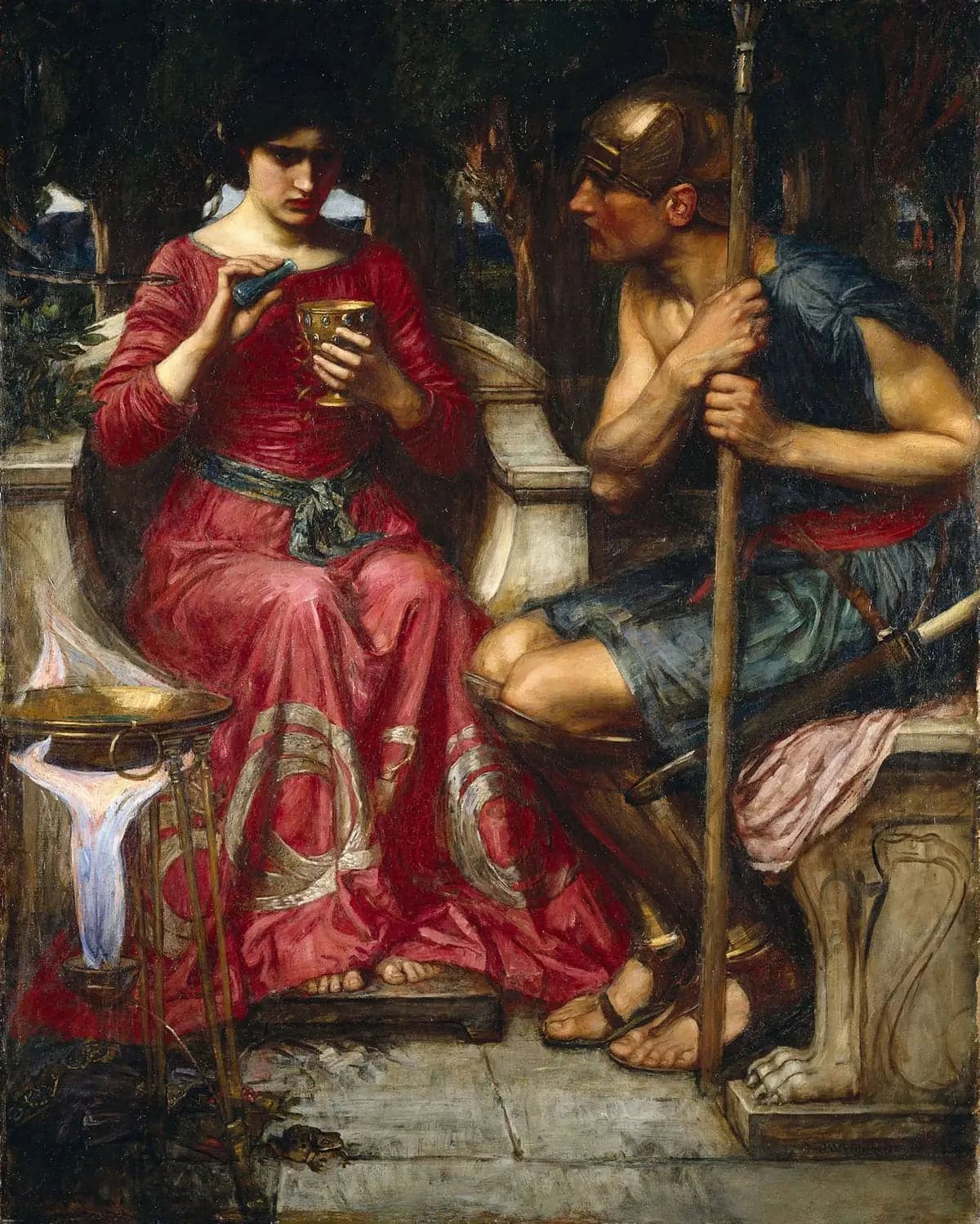
Jason and Medea
Scene depicted
The canvas depicts a crucial moment in the myth, where Medea, the legendary sorceress, prepares to flee with Jason, the Greek hero. Her eyes reflect both deep determination and palpable melancholy. The scene, bathed in shades of blue and gold, captures the moment of a heart-wrenching choice between love and duty. The painting evokes dramatic tension, heightened by the palpable anticipation of a tragic fate.
Historical context
Created in 1907 in London, this painting is emblematic of the Pre-Raphaelite movement, which flourished in the United Kingdom during the second half of the 19th century. Waterhouse's work, inspired by the myth of Jason and Medea, is set in a context where romanticism and symbolism intertwined to create a rich and evocative atmosphere. Currently, the canvas is housed at the Tate Britain in London, and its dimensions are 152.4 cm x 61 cm.
Place in the artist's career
This painting represents one of the peaks of Waterhouse's career, echoing his previous work, “The Lady of Shalott,” and foreshadowing similar themes in “Penelope and the Suitors.” Throughout his creations, Waterhouse developed his talent for capturing light and emotion. Jason and Medea, with its bold composition, illustrates a narrative harmony between heroism and vulnerability.
Anecdote
“The magic of myths is such that it transcends time and space.” These words from Waterhouse resonate deeply in the genesis of the masterpiece . In the heart of a London spring, while strolling near the Thames, he felt the vibrant call of classical mythology. It was there that the idea of immortalizing Jason and Medea took shape, blending with the soft sounds of the river and the golden morning light, thus creating the evocative power of the painting .