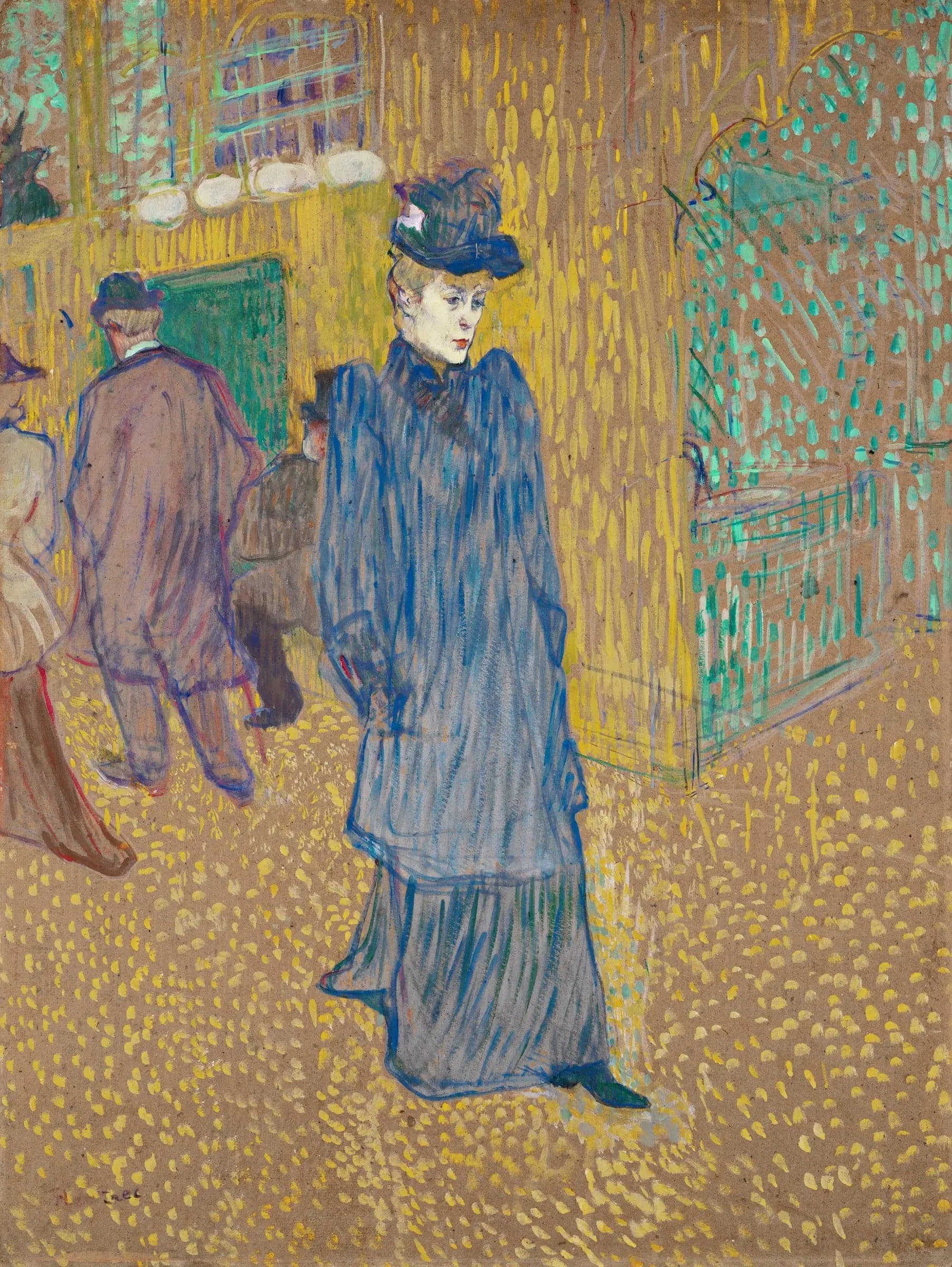
Jane Avril Leaving the Moulin-Rouge - Henri de Toulouse
- Original dimensions
- 69.9 x 85.7 cm
- Museum
- Wadsworth Atheneum
- Year
- 1892
Scene depicted
This painting depicts Jane Avril, a charismatic dancer, leaving the Moulin-Rouge with grace and flamboyance. The sparkling lights of the cabaret blend with Avril's facial expression, embodying the spirit of the party while hinting at an underlying melancholy. The lesbian energy of the scene, with its fluid movements and bright contrasts, transports us into the spectacular and vibrant universe of this era.
Historical context
Created in 1892, at the heart of the Belle Époque in Paris, Jane Avril leaving the Moulin-Rouge is part of the post impressionist movement. This painting, currently housed at the Wadsworth Atheneum in Hartford, Connecticut, reflects the dynamism and liveliness of the era, revealing the pleasures and excesses of a bustling Paris. With its generous dimensions, this canvas captures the essence of Parisian nights where music and dance intertwined with passions and artistic inspirations.
Place in the artist's career
Jane Avril leaving the Moulin-Rouge represents a phase of maturity in Toulouse-Lautrec's career. Referencing his other famous works, such as The Troupe of Mademoiselle Églantine and At the Moulin-Rouge , one can observe an evolution in the artist's technique, where the mastery of color and the expressive character of the figures reach an artistic peak.
Anecdote
Henri de Toulouse-Lautrec once declared: “A moment captured, an emotion frozen, that is life in painting.” The creation of this masterpiece is said to have occurred during one of his long evenings at the Moulin-Rouge, where he observed Jane Avril, an icon of the cabaret, flourishing on stage. This canvas is its vibrant resonance.