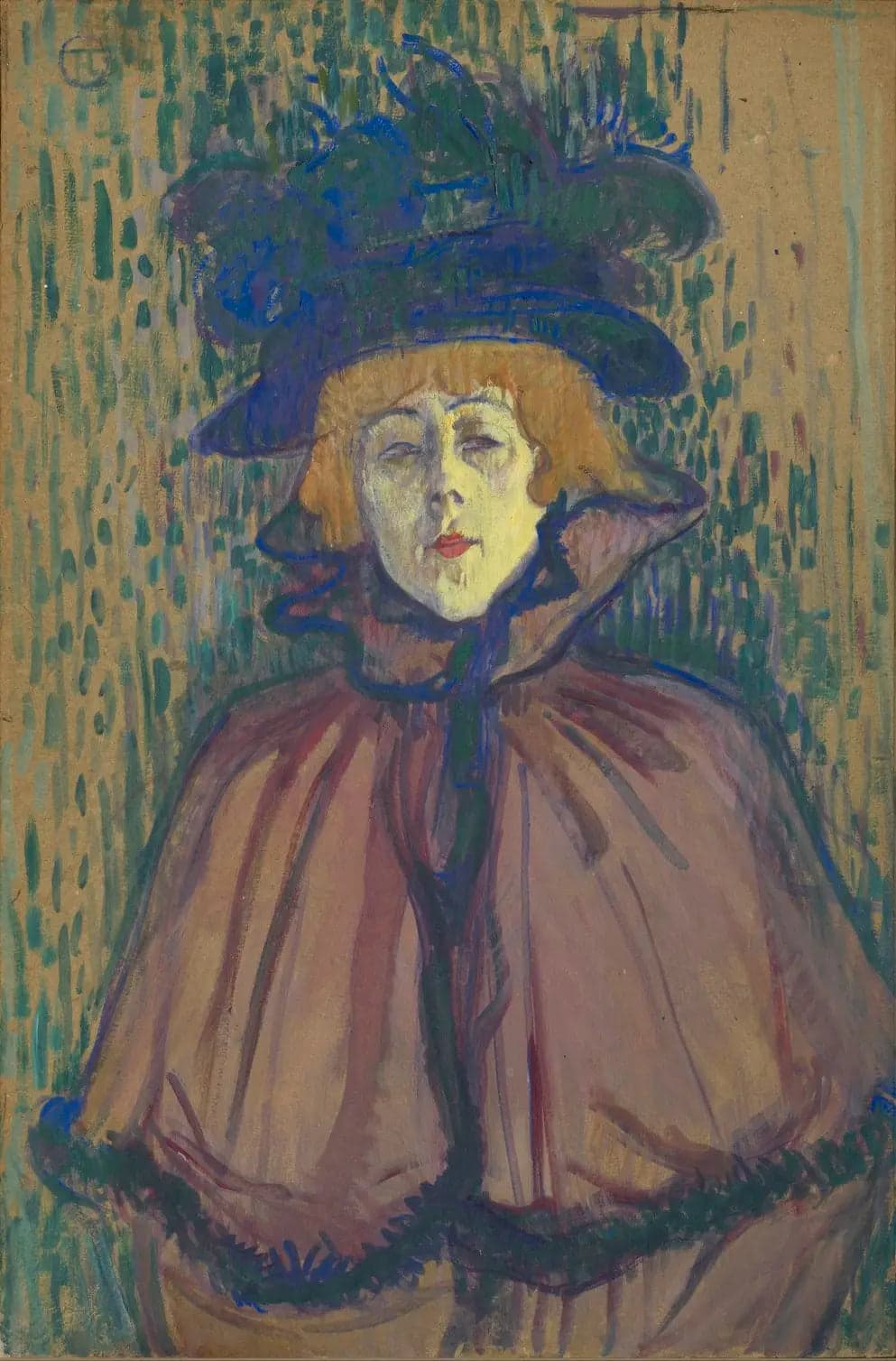
Jane Avril - Henri de Toulouse
- Original dimensions
- 42.2 x 63.2 cm
- Museum
- Clark Art Institute
- Year
- 1891
Scene depicted
“Jane Avril” is much more than a simple painting ; it is an ode to the famous cancan dancer, who embodies all the liveliness and allure of Parisian life. This composition showcases bold femininity, the lightness of movement, and the brilliance of an era when cabarets were the heart of culture and entertainment. The emotional intensity that emanates from the canvas transports us directly into this vibrant atmosphere.
Historical context
Created in 1891, in the heart of Paris, the painting "Jane Avril" by Toulouse-Lautrec belongs to the artistic movement of post-impressionism . This period marked by the dynamism of the Belle Époque saw the birth of many vibrant works, drawn from Parisian nightlife. Currently, this canvas is preserved at the Clark Art Institute , where it continues to move visitors with its harmonious dimensions of 42.2 x 63.2 cm.
Place in the artist's career
“Jane Avril” represents a turning point in Toulouse-Lautrec's career, marking a perfect balance between technique and emotion. This masterpiece falls within a period when the artist began to master the capture of human movements and emotions. In parallel, other works such as “At the Moulin Rouge” and “The Toilette” also testify to this deep understanding of the human psyche and the artistic environment of his time.
Anecdote
“Beauty lies in the emotion captured on the canvas, a moment etched for eternity.” This quote resonates deeply with the essence of his masterpiece . Inspired by the grace of Jane Avril, he painted her during an evening in Montmartre, where the murmur of conversations and the scent of spring flowers floated in the air, nourishing his creative impulse and his desire to capture the ephemeral on his painting .