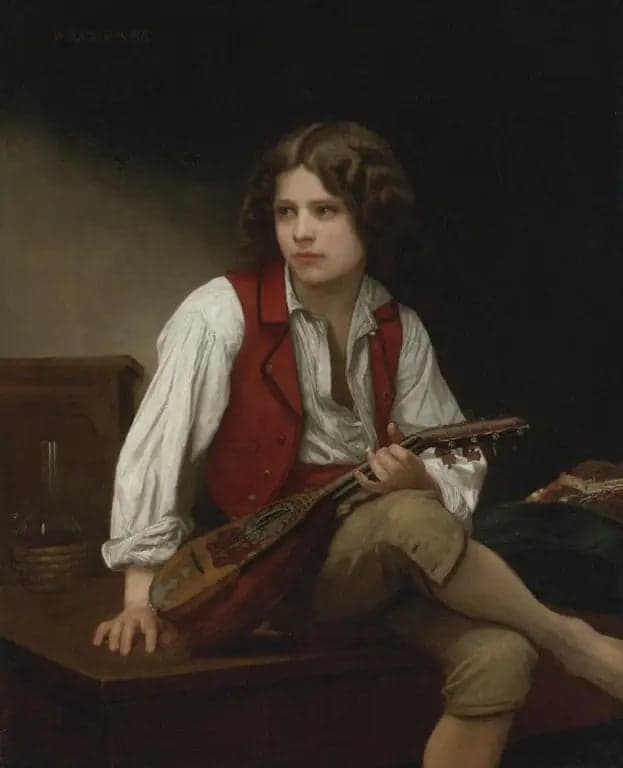
Italian with the Mandolin
- Original dimensions
- 83.2 x 100.3 cm
- Museum
- Not specified
- Year
- 1870
Scene depicted
This canvas depicts a captivating young man, sitting, delicately playing the mandolin. His gaze, imbued with melancholy, captures attention, while the soft light caresses his face. The elements of nature intertwine with his musical breath, creating an intimate atmosphere where the artist invites us to share a moment suspended in time.
Historical context
This painting masterfully created in 1870, a period rich in artistic transformations in Paris, the beating heart of the academic movement. The city, at the crossroads of modernity and traditions, is the cradle of Bouguereau's pictorial expression, a virtuoso of illuminating the human condition through art. Currently, the canvas remains a treasure in the realm of private collection, admired by art enthusiasts.
Place in the artist's career
“Italian with the Mandolin” marks a promising turning point in Bouguereau's career, signifying a shift towards a more emotional artistic realization. Alongside the famous “Nymph and Satyr,” this painting reveals superior technical refinement, while “The Virgin with Angels” foreshadows a stylistic maturity that will culminate in his later works.
Anecdote
“The beauty of the simple aspects of life, like a melody played on the mandolin, is the essence of my creation.” On a sunny spring morning, sitting in the garden of his home in La Rochelle, Bouguereau sketched the first lines of this masterpiece . The song of the birds and the scent of blooming flowers nourished his imagination, transforming an ordinary encounter into a painting vibrant with life.