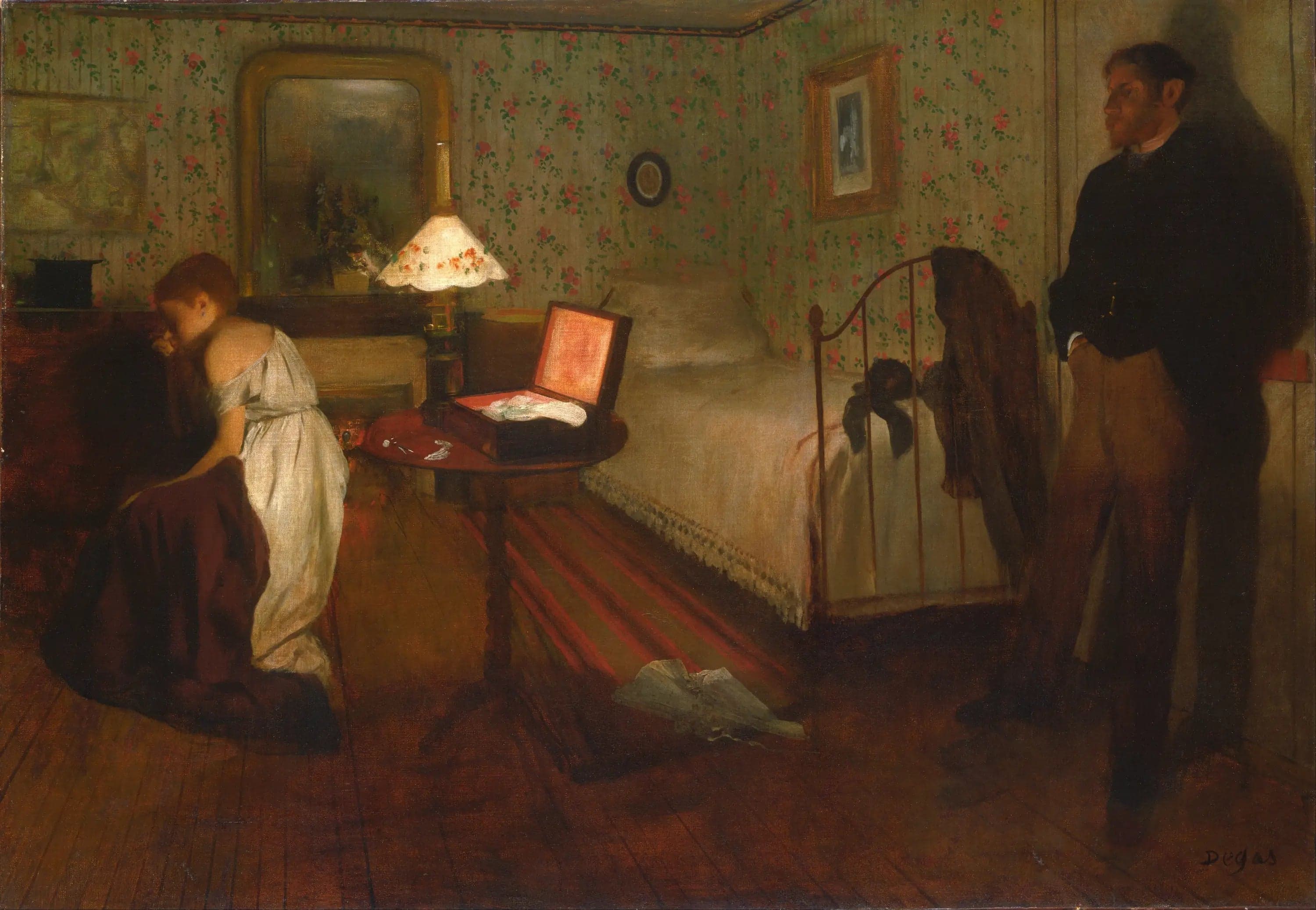
Interior
- Original dimensions
- 114.3 x 81.3 cm
- Museum
- Philadelphia Museum of Art
- Year
- 1868
Scene depicted
In the painting "Interior," Degas transports us to an intimate scene, where a woman is lost in her thoughts in a private space. The composition invites us to question her inner world, fostering an atmosphere of warmth and silence. The details of the furniture, the play of light, and the absence of movement create a haunting beauty that compels contemplation.
Historical context
Created in 1868 in Paris, the painting "Interior" is part of the Impressionist movement, reflecting a time when art explores the nuances of everyday life. This work by Edgar Degas , currently housed at the Philadelphia Museum of Art , reveals not only his talent but also his boldness in capturing moments of modern intimacy, during a time of great change.
Place in the artist's career
"Interior" represents a pivotal moment in the career of Edgar Degas . Emerging as one of the masters of Impressionism , he finds a unique path between abstraction and figuration. Alongside his works "The Dance Class" and "Dancers at Rest," this masterpiece highlights the evolution of his technique and emotional approach.
Anecdote
“The light of a spring morning on a face, that never reproduces.” This quote, inspired by the immense artist, evokes the moment of the creation of this painting . Perhaps it was a sweet Parisian morning when the sun's rays slipped through the curtains, making this moment almost sacred, like the echo of a past memory.