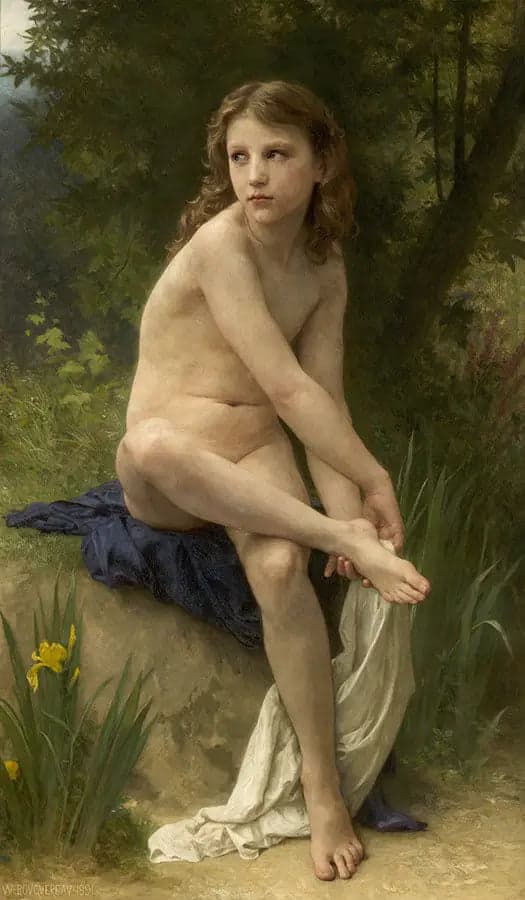
Innocence
- Original dimensions
- 52.5 x 100 cm
- Museum
- Not specified
- Year
- 1893
Scene depicted
In this pictorial work, Bouguereau captures the delicate nuances of eternal childhood. The scene, imbued with tenderness, takes us through a lush garden where the sun caresses the pure face of a little girl wearing a crown of flowers. The artist celebrates, beyond the composition , pure, nascent, and ephemeral innocence, bringing to life a suspended moment where time no longer matters.
Historical context
Created in 1893, at a time when French art embraces realism and academicism , L'Innocence is part of the neoclassicism movement. Bouguereau, as a fervent advocate of idealism, creates this canvas drawing on a rich artistic heritage, at the heart of the Belle Époque period. Currently, this painting , although not exhibited in a specific museum, remains an iconic piece long admired in private collections.
Place in the artist's career
L'Innocence stands as a stylistic peak in Bouguereau's career, illustrating his heightened technical finesse. Between Les Baigneuses (1884) and Le Réveil (1891), it is evident that this painting reflects a notable advancement in the mastery of light and details, illuminating the deep connection between the artist and his subjects.
Anecdote
“The purity of hearts inspires me,” Bouguereau often said, thus evoking the young children he painted so much. One spring morning, while walking through the blooming gardens of Bordeaux, he crossed the gaze of a little girl with a bright smile. This encounter, imbued with sweetness, would be the starting point of his masterpiece , a Birth of Innocence embodied in this painting .