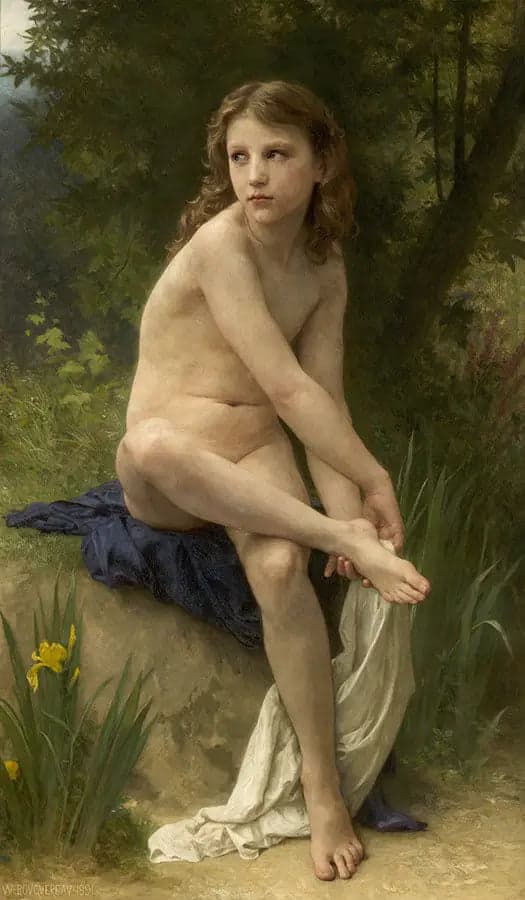
Innocence
- Original dimensions
- 76.5 x 130 cm
- Museum
- National Museum of Fine Arts of Cuba
- Year
- 1891
Scene depicted
At the heart of this canvas , a delicate young girl looks at us, running along the path of unspoiled nature. She embodies the beauty of innocence and the joy of living, her sparkling eyes capturing the light of dawn. Bouguereau's harmonious composition immerses us in a peaceful world, where every detail illuminates the virtuous emotions that childhood conveys.
Historical context
Created in 1891 in Paris, this painting is emblematic of the artistic realism that thrived at the end of the 19th century. In this whirlwind of creativity, Bouguereau managed to capture the purity of childhood by combining technical sophistication and emotional sensitivity. Currently on display at the National Museum of Fine Arts of Cuba, this canvas is part of an era when academic art dominated the cultural scene, celebrating both formal beauty and the elegance of the subjects represented.
Place in the artist's career
This painting represents a peak in Bouguereau's career, combining mastered technique with heightened sensitivity. At that time, his other paintings , such as “The Virgin and Child” and “The Priestess of Love,” illustrate his artistic evolution towards themes of tenderness and humanity. Innocence thus constitutes a crucial milestone in his stylistic development.
Anecdote
“Beauty is a promise of happiness,” said Bouguereau. His inspiration for creating Innocence emerged on a spring morning as he observed children playing in a sunny garden. The crystalline laughter resonated around him, and this vision of youth full of serenity infused a vibrant soul into his masterpiece .