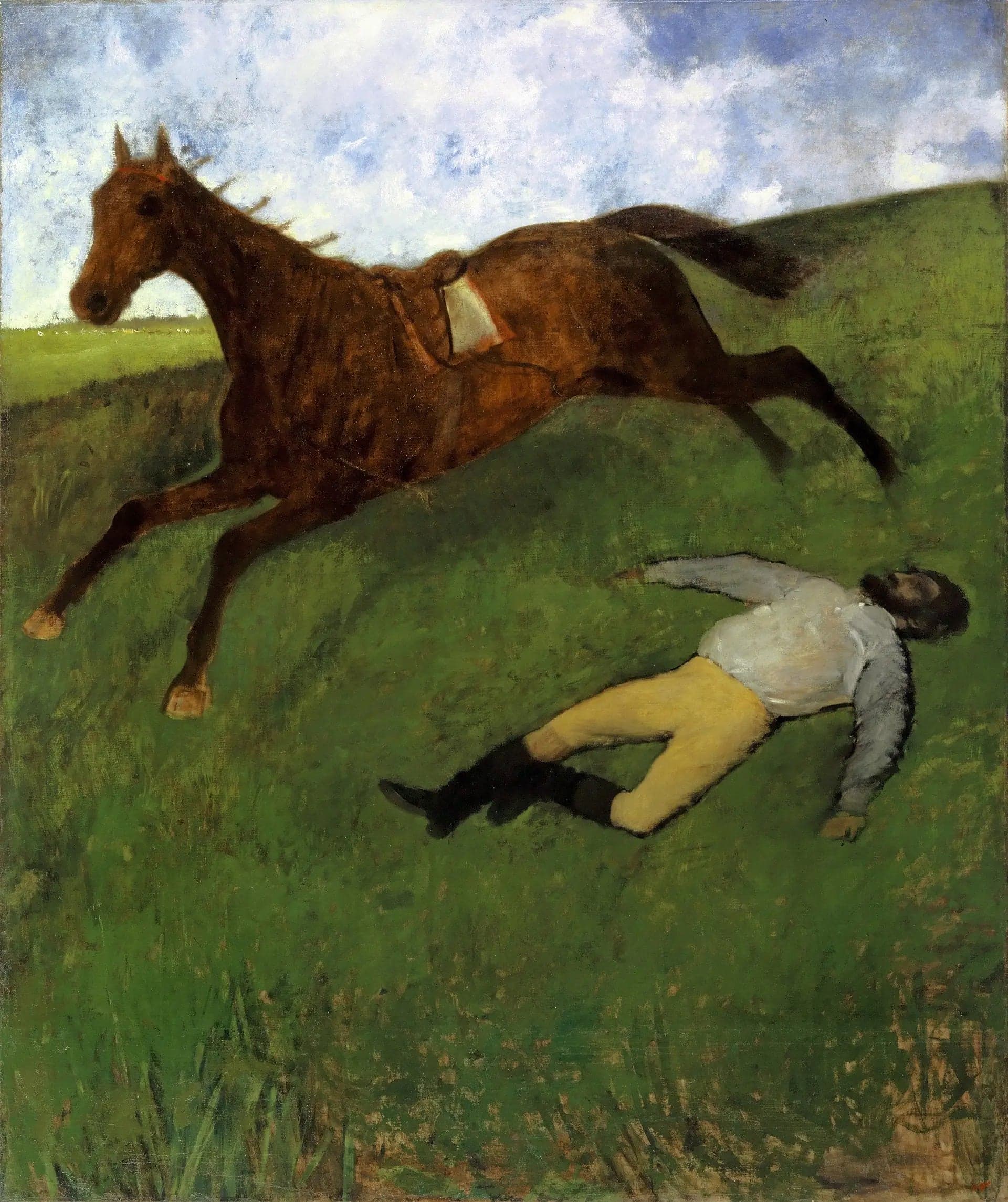
Injured Jockey
- Original dimensions
- 151 x 180 cm
- Museum
- Kunstmuseum Basel
- Year
- 1897
Scene depicted
The painting, Jockey blessé , depicts with palpable intensity a jockey sitting on the ground, injured after his fall. His marked face, combined with the anxiety of the horses in the background, transports us into the adrenaline of the races. This poignant scene is a metaphor for struggle, where sporting passion and risks overlap, masterfully realized by Degas.
Historical context
Created in 1897, the iconic painting by Degas, Jockey blessé , is set against the vibrant backdrop of late 19th century Paris. This painting, representing the passion for equestrian sports, is at the heart of the Impressionist movement, marking a time when light and movement intertwine in art. Currently housed at the Kunstmuseum Basel, this canvas measures 151 x 180 cm, revealing the grandeur of the work.
Place in the artist's career
Jockey blessé represents a central period in Degas's career, marking his technical evolution towards a more expressive interpretation of movement. In parallel, works such as The Dance Class and The Dancers with a Doll highlight his ongoing exploration of the body in motion and human emotions, making his style unique and memorable.
Anecdote
“The beauty of a horse's movement, the pain of a man” could have been said by Degas, evoking the very essence of his masterpiece . It was on a freezing morning, watching the races from a box, that he felt this duality. An inspiration born from pure emotion, captured with finesse in Jockey blessé , echoes the fragility of life.