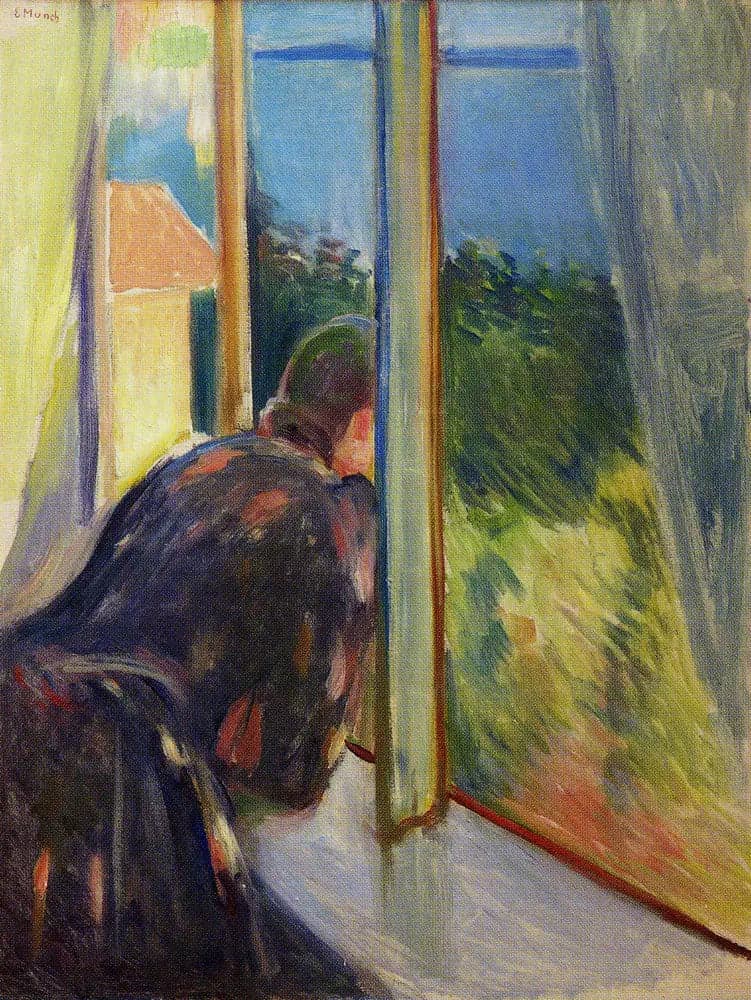
Inger by the Window
- Original dimensions
- 69 x 90 cm
- Museum
- Not specified
- Year
- 1892
Scene depicted
In this painting , Munch captures an intimate moment: a young woman sitting by a window, lost in her thoughts. The rays of sunlight caress her face, creating a dialogue between light and shadow that reveals her silent contemplation. The painting evokes an atmosphere of serenity but also of latent anxiety, a duality characteristic of Munch's art that touches on the human being in all its complexity.
Historical context
Created in 1892, this painting is at the heart of the expressionist movement, launched at the edges of the vibrant city of Oslo, Norway. The work, reflecting a time when human emotions were captured and translated onto canvas , powerfully evokes the inner turmoil of modern man. Currently, this painting remains in a private collection, thus preserving its intimate history and powerful cultural heritage.
Place in the artist's career
“Inger près de la fenêtre” stands as a turning point in the career of Edvard Munch , symbolizing his transition to artistic maturity. At this time, he was already asserting himself with works like “The Scream” and “The Madonna” which possess a similar emotional intensity but explore different themes. This composition is a milestone reflecting his virtuosity and growing talent.
Anecdote
Edvard Munch once stated: “Art does not reproduce the visible; it makes visible.” Inspired on a gentle spring morning, he encountered the serene face of Inger, an almost ethereal model, near a window embracing daylight. This fleeting encounter gave birth to a pictorial work that is laden with deep reflections and nuanced feelings.