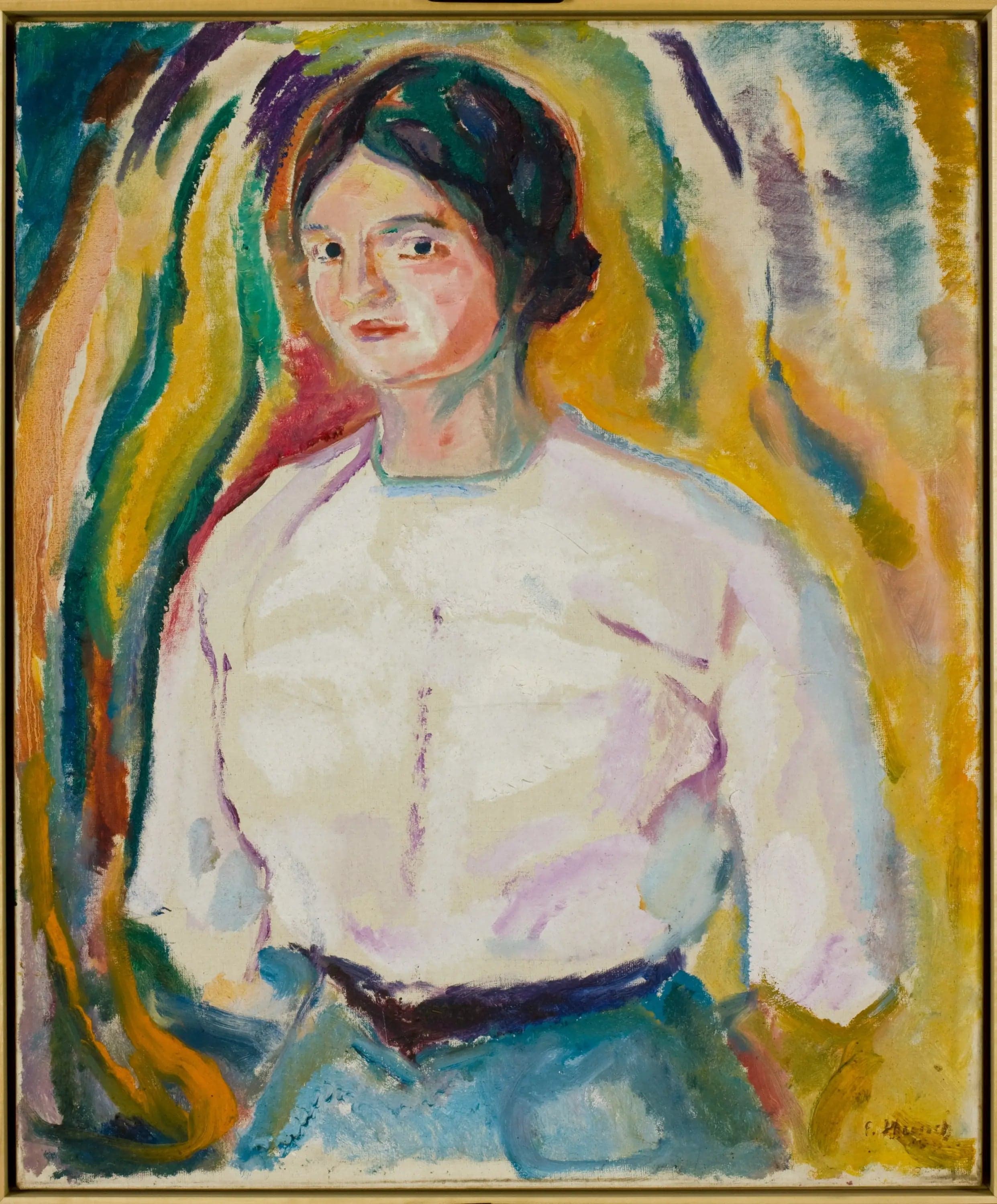
Ingeborg with her hands behind her back
- Original dimensions
- 69 x 84 cm
- Museum
- Munch Museum
- Year
- 1912
Scene depicted
In this painting , Munch invites us to observe Ingeborg, an enigmatic character, whose lost gaze intrigues and captivates. Standing gracefully, her hands hidden behind her back, she embodies a disturbing softness. The scene breathes an atmosphere of mystery and reflection, perfectly illustrating the inner turmoil so characteristic of expressionism .
Historical context
Created in 1912, Ingeborg with her hands behind her back is rooted in the rich artistic soil of Norway, conducive to the flourishing of the expressionist movement. This painting, now housed in the Munch Museum , captures the essence of an era marked by a quest for personal and emotional identity. The dimensions of this canvas also make it a majestic element, carrying a unique story.
Place in the artist's career
Ingeborg with her hands behind her back positions itself at a key moment in Munch's career, testifying to a defined style and mastery of emotions. Alongside The Scream and The Madonna , this work is part of a series of delicate vignettes that explore the human condition through an intimate and tormented prism.
Anecdote
“True beauty lies in the emotion captured by the eyes,” could have said Edvard Munch while reflecting on his work. Inspired by fleeting encounters during a misty morning, he translated this vision into a vibrant painting , echoing the depth of exchanged glances and the melancholy of a shared moment.
Major exhibitions
Edvard Munch and his models: 1912-1943