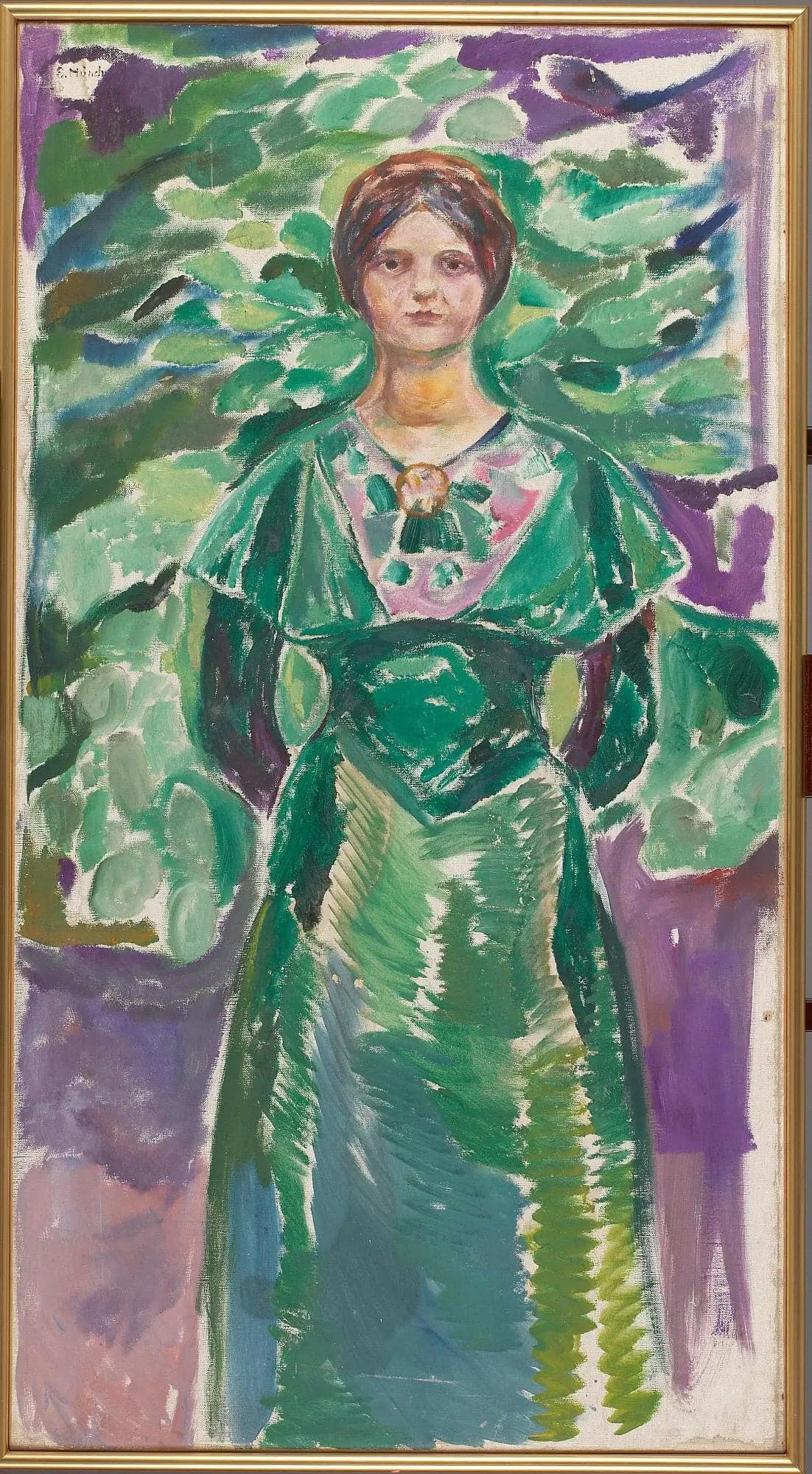
Ingeborg Kaurin
- Original dimensions
- 37 x 55 cm
- Museum
- Munch Museum
- Year
- 1911
Scene depicted
In this pictorial work , Munch captures the very essence of a woman, both gentle and unsettling. Her introspective gaze and delicate expression evoke a depth of soul. Each brushstroke tells a story, a quest for identity, and a reflection of an era. A painting where beauty and melancholy coexist harmoniously.
Historical context
Created in 1911 in Oslo, the painting "Ingeborg Kaurin" belongs to the expressionist movement that characterizes the work of Edvard Munch . This painting, currently exhibited at the Munch Museum, offers a fascinating glimpse into a time when art intertwines with raw emotions, thus revealing the undeniable talent of the artist.
Place in the artist's career
This painting sits at a crossroads in Munch's career, a period where he refines his style. Compared to other iconic paintings such as "The Scream" and "Madonna," "Ingeborg Kaurin" testifies to an evolution in the expression of human psychology, a maturation in the representation of inner emotions.
Anecdote
"Inspiration is often a fleeting breath, captured in the silent garden of the soul," said Munch. Perhaps the canvas was conceived on a spring morning, where the soft golden light bathed the scene, infusing vibrant life into Ingeborg's face, while paradoxically reflecting the emotional intensity characteristic of his work.
Major exhibitions
Edvard Munch and his models: 1912-1943