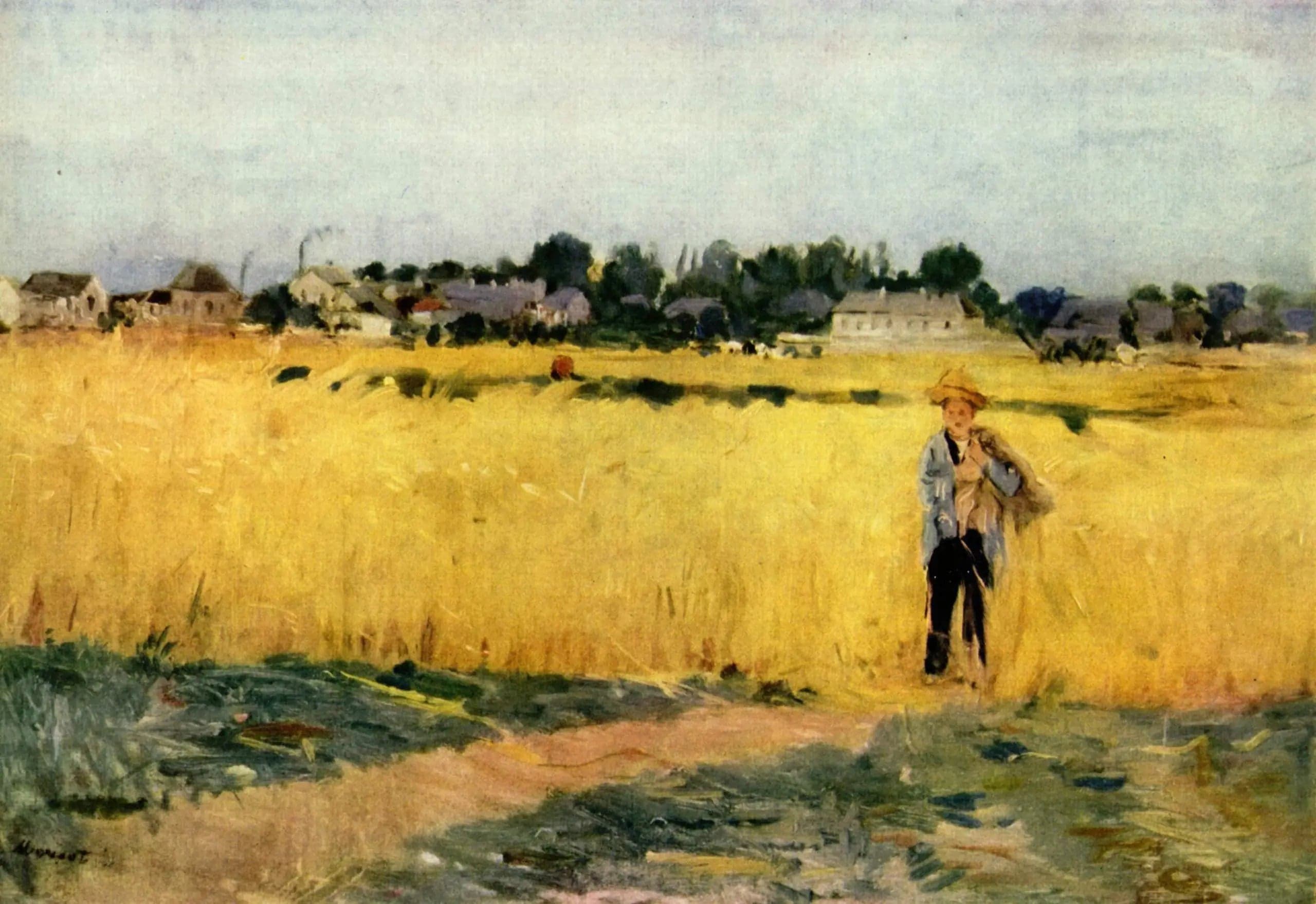
In the Wheat Fields
- Original dimensions
- 69 x 47 cm
- Museum
- Orsay Museum
- Year
- 1875
Scene depicted
In the Wheat invites a delicate contemplation of the golden landscapes of a field, where the simplicity of rural life takes on its full dimension. The painting, a true ode to nature, immerses us in a bucolic atmosphere, where each brushstroke breathes the light and fresh air of sunny days. The wheat, swayed by the wind, narrates a story of harmony between man and his environment.
Historical context
Created in 1875 in Paris, in the heart of France, this painting illustrates the Impressionist movement, dear to the artist and her contemporaries. At that time, the city is an artistic hub, where light and movement are captured on canvas. The canvas original is now located at the Orsay Museum , a sanctuary of art wonders, where the dimensions of this work mark its presence: 69 cm wide by 47 cm high.
Place in the artist's career
This painting , In the Wheat, is situated at a crucial time in the career of Berthe Morisot , as she asserts herself as one of the major figures of Impressionism . By looking at this canvas , we can compare it to her famous work The Cradle, as well as to Mother and Child, to observe the evolution of her technique and the emotions conveyed, from domestic tenderness to a celebration of nature.
Anecdote
“Nature speaks louder than all words,” once confided Berthe Morisot , inspired by the gentle whispers of the fields as far as the eye can see. It is on a spring morning, bathed in light, that the artist captures this serene scene, where each blade of wheat seems to stretch under the caress of the wind, thus becoming the beating heart of her masterpiece .