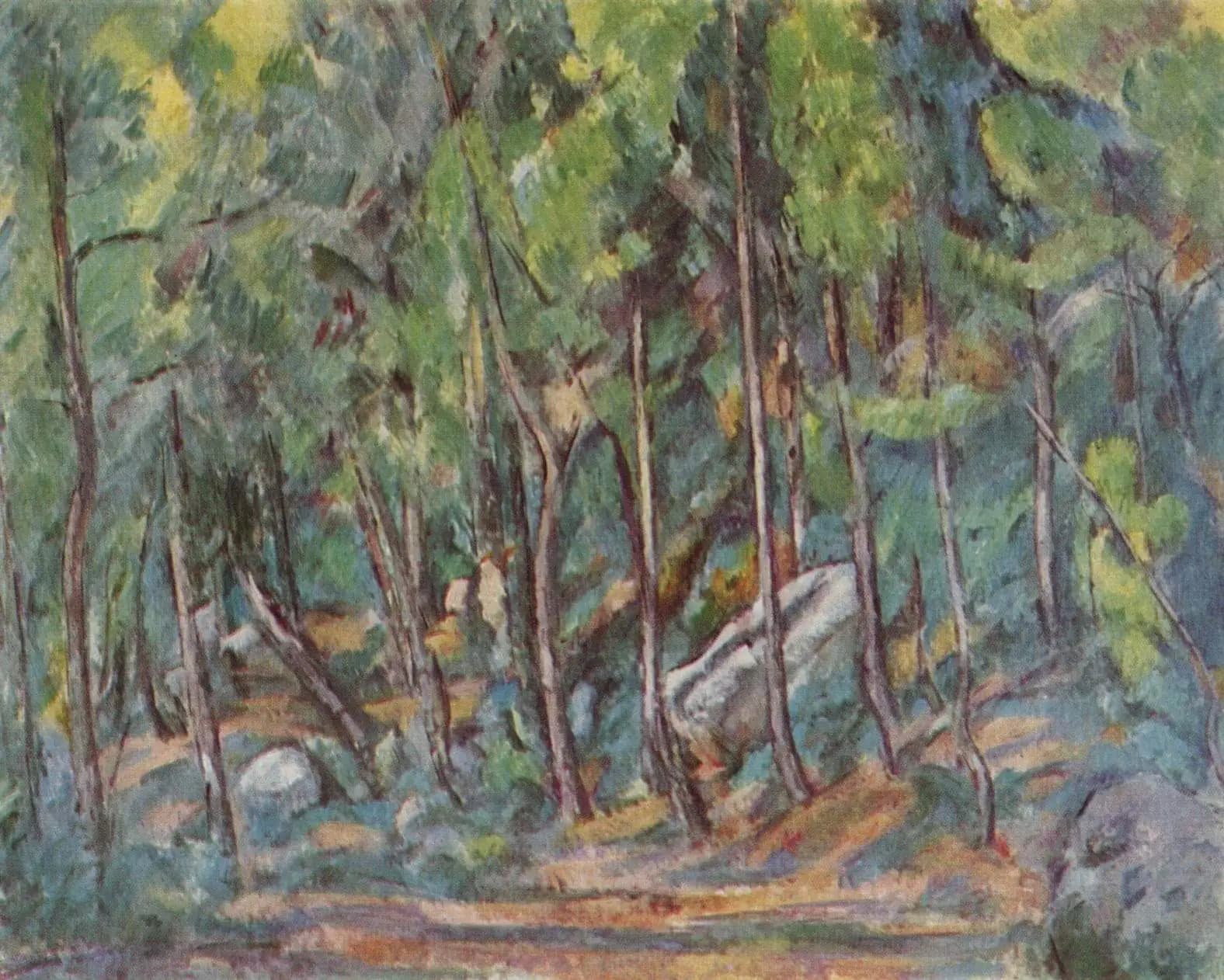
In the Forest of Fontainebleau
- Original dimensions
- 80 x 64 cm
- Museum
- Not specified
- Year
- 1879
Scene depicted
The painting “In the Forest of Fontainebleau” celebrates the wild and serene beauty of nature. Through its organic shapes and vibrant colors, Cézanne immerses us in a universe where light plays with the foliage, where the green of the trees reflects in the gentle silence of a sunny morning. Every detail of this pictorial work invites contemplation, offering us a moment of escape from the tumult of urban life.
Historical context
Created in 1879, this painting is set in the picturesque landscape of the Forest of Fontainebleau, a region favored by artists of the Impressionist era. Paul Cézanne , a major figure of this movement, managed to capture the very essence of nature through this canvas . Although the painting is currently not located in a famous museum, its dimensions (80 x 64 cm) testify to the artist's mastery in playing with space and light.
Place in the artist's career
“In the Forest of Fontainebleau” stands as a turning point in Cézanne's career, marking his period of quest for depth and color. In contrast, works such as “The Montagne Sainte-Victoire” and “The Card Players” reveal his stylistic evolution, moving from realistic representation to more abstract compositions, thus stating his central role in the development of modern art.
Anecdote
“I want to paint like a tree grows,” Cézanne is said to have declared, inspired by the whispers of the forest and the song of the birds. This statement resonates strongly when contemplating In the Forest of Fontainebleau , where each brushstroke evokes a story and an emotion, a suspended moment captured at the heart of nature.